
Grvt is a self-custodial on-chain wealth platform that combines yield-bearing savings, institutional-grade investment products, and spot and perpetual trading across crypto, equities, and commodities within a single account balance. Every deposit automatically earns a base yield while remaining available as collateral across the platform, eliminating the need to move assets between separate products. $GRVT is the native token of the Grvt platform.
The $GRVT Token
Supply
Grvt will have a fixed supply of 1,000,000,000 tokens (1 Billion $GRVT).
Latest allocation, unlocks, price and trading venues
You can track this information at independent third-party websites including
Contract Address
Grvt is an ERC20 token issued on Ethereum. Please find the contract address here.
How is Grvt Membership related to $GRVT tokens?
Grvt Membership is a tiered program that rewards you for holding $GRVT tokens. There are four tiers: Basic, Silver, Gold, and Platinum. The more tokens you commit and the longer you commit them, the higher your tier and the better your benefits. Your tier is determined by two things: how many tokens you lock and how long you lock them for. You must meet both the minimum amount and the minimum duration for a tier. the exact benefits and different tiers are displayed in the image below.
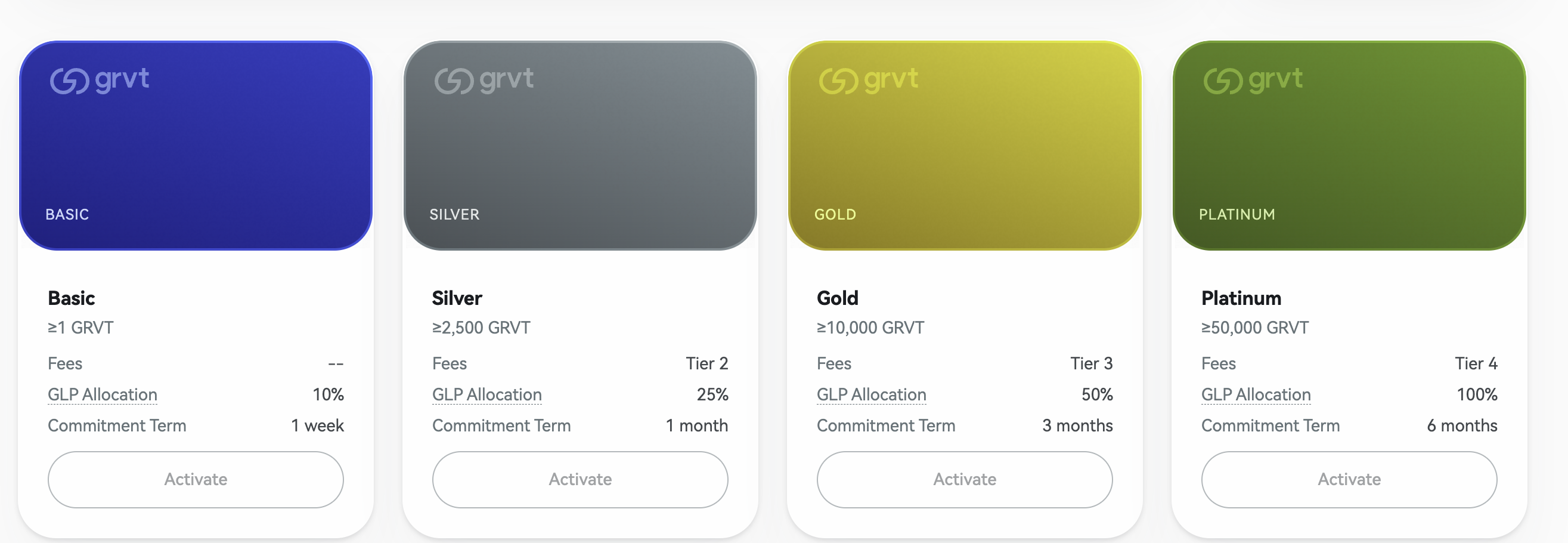
To learn more about the membership and $GRVT with up-to-date benefits, please check the help center and this program is subject to Airdrop terms and conditions.
Transfer of $GRVT and other digital assets between accounts on the Grvt platform
Transfers between accounts on the Grvt platform are permitted for USDT and USDC only. All other digital assets, including $GRVT, ETH and BTC, cannot be transferred between accounts on the platform. This restriction applies to transfers between accounts only. Deposits and withdrawals are separate and remain subject to the compliance reviews described in this article.
How are transfers between accounts controlled?
Every transfer instruction submitted to the GRVT chain smart contract requires a co-signature from our Transaction Monitoring System before it can be included. A transfer instruction without that co-signature cannot be included, regardless of how it is constructed or who submits it. The Transaction Monitoring System co-signs programmatically, evaluating each transfer instruction against a predefined ruleset published below. Denial is the default state: a co-signature is issued only where the published ruleset is affirmatively satisfied, and any failure condition produces a denial rather than a pass-through. Transfer instructions for digital assets other than USDT and USDC do not satisfy the ruleset, are not co-signed, and therefore cannot be included.
Can Grvt manually approve a transfer, or make an exception in an individual case?
No. There is no override path, no manual approval queue, and no per-transaction exception mechanism. Our personnel cannot approve a transfer that the ruleset rejects, or reject one that it permits. Staff do not adjudicate individual transfers.
Can Grvt change the transfer ruleset on its own?
No. Changing the ruleset is a governed action that requires third-party approval. The approving committee includes external investors and ZKsync, whose approval is required, so Grvt cannot alter the ruleset on its own authority. Any ruleset in force is published below.
What is our transfer screening policy?
Grvt L2’s transfer screening policy only applies for cross-wallet transfers. Transferring balances between sub-accounts of the same wallet will not be governed by our transfer screening policy. Grvt L2 only permits cross-wallet transfers for two tokens: USDT and USDC.
All other tokens are not allowed to be transferred across any wallets within Grvt L2.
Grvt's wallet screening is powered by Elliptic (Know Your Address Software), which assigns every wallet a risk score based on trigger rules, proximity, and % exposure. Screening occurs at the point of every transfer. Transfers scoring below a pre-defined threshold will be blocked from transferring. Withdrawals and deposits are governed by a separate policy outlined here.