Grvt Liquidity Provider (GLP): What It Is and How It Works
Grvt Liquidity Provider (GLP) is a delta-neutral market-making strategy that opens institutional-grade yield to everyday users on Grvt.
For most of crypto's history, market making has been a closed game. The desks that quote prices on perp DEXes, capturing spreads, funding, and liquidation flow, have been institutional teams running their own infrastructure, with returns flowing to a handful of partners. Retail liquidity providers, by contrast, have been handed pool tokens that look like passive yield but quietly carry the directional risk of an entire asset basket.
Grvt Liquidity Provider (GLP) is built differently. It's a delta-neutral, community-owned market-making strategy that pipes professional-grade yield directly to depositors, with no performance fees and no profit share to a strategy manager.
This article explains what GLP is, how it generates returns, and how it compares to the other major liquidity products in the space, Hyperliquid's HLP, GMX's GLP, and Jupiter's JLP.
What is Grvt Liquidity Provider (GLP)?
Grvt Liquidity Provider (GLP) is a delta-neutral market-making strategy that runs on Grvt's privacy-first, capital-productive DEX. Users deposit USDT, the strategy provides liquidity across Grvt's perpetual markets, and yield flows back to depositors on a transparent, smart-contract-managed schedule.
Three things make GLP distinct:
It's strategy-based, not pool-based. Most "LP tokens" in DeFi are claims on a basket of crypto assets. GLP isn't. It's a vault that runs an actual trading strategy designed and managed by professionals, closer to investing in a quant fund than to depositing into an AMM.
It's delta-neutral by design. The strategy is constructed to neutralize directional exposure. Returns come from market-making spreads and funding flows, not from being long or short any underlying asset.
There are no performance fees and no management fees. Most institutional strategies charge 2-and-20 or some variant of carry. GLP doesn't. All yield is distributed directly to GLP participants.
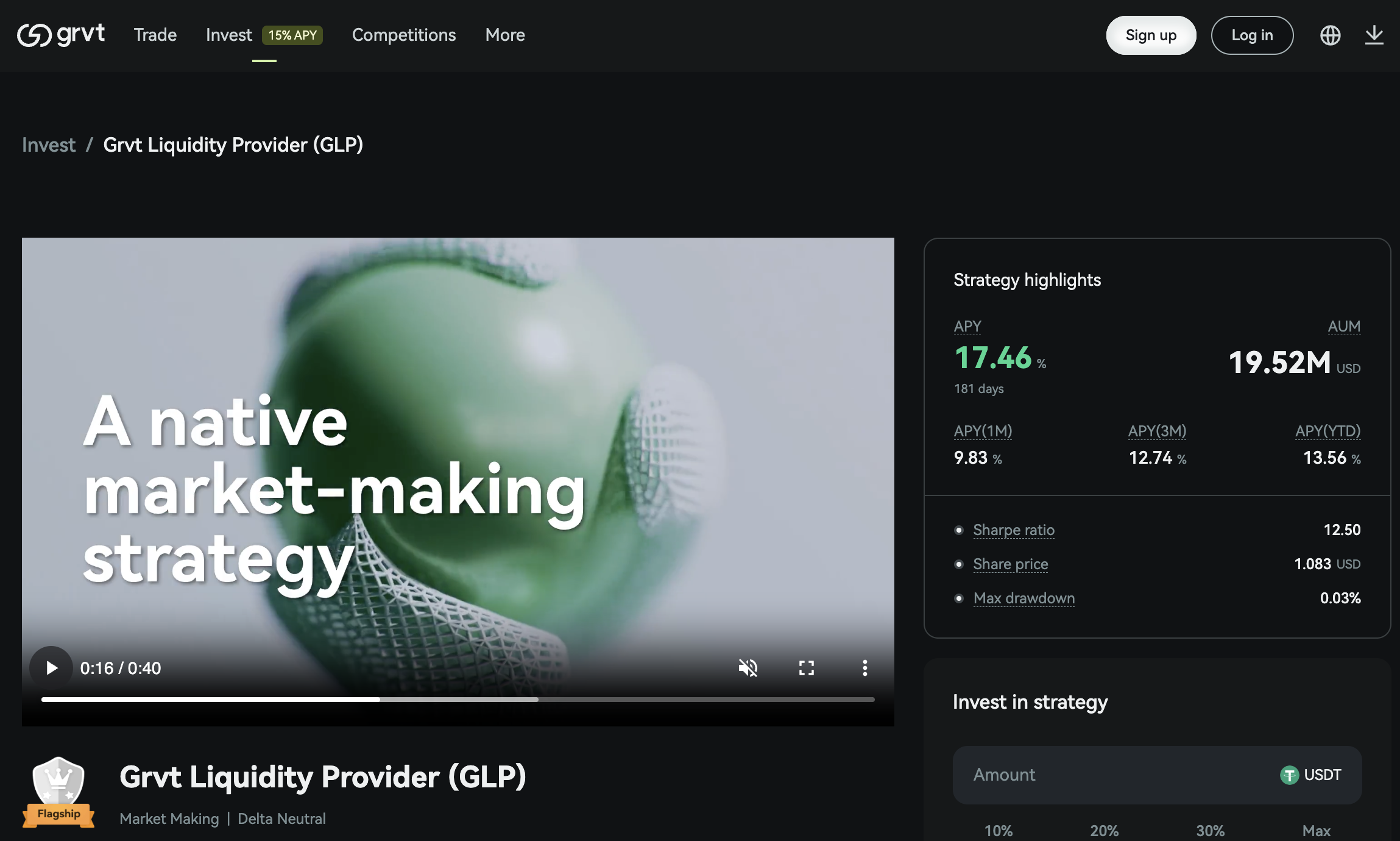
The strategy is run in partnership with a veteran global trading team with over 40 years of combined market-making and risk-management experience. Over a six-month live trading period, GLP produced a Sharpe ratio of 7.6, a measure of risk-adjusted return that, for context, would put it well above what most traditional hedge funds publish.
How GLP differs from typical "LP tokens”
The most important thing to understand about Grvt's GLP is what it isn't. It is not a basket of tokens packaged into a single LP claim. It is not a passive AMM share. It is not a counterparty position taking the other side of every trade on the exchange.
Almost every other "LP" or "vault" product in perp DEX land falls into one of two buckets:
- Pool-based LP tokens that hold a basket of crypto assets and earn fees as traders open leveraged positions against the pool. GMX's GLV (the successor to GMX's deprecated GLP) and Jupiter's JLP both work this way. The yield comes with full price exposure to the underlying basket.
- Protocol vaults that run market-making and liquidation strategies on behalf of the protocol. Hyperliquid's HLP is the canonical example. These tend to be more market-neutral but vary in transparency about strategy.
Grvt's GLP is closer to the second bucket but with some defining features: it's explicitly delta-neutral, the strategy team is named and accountable, the fee structure is zero, and the vault is governed by smart contracts rather than protocol-controlled wallets.
GLP vs HLP vs GLV vs JLP: a side-by-side comparison
Here's how the four products compare across the dimensions LPs care about most. Note: GMX's older GLP was retired in the GMX V2 migration; the active GMX LP product today is GLV (GMX Liquidity Vaults), so that's what we benchmark against.
| Feature | Grvt GLP | Hyperliquid HLP | GMX GLV | Jupiter JLP |
|---|---|---|---|---|
| Latest APY* | ~17% APR | Varies | ~1-6% | ~8% |
| Underlying chain | ZKSync | Hyperliquid L1 | Arbitrum / Avalanche | Solana |
| Deposit asset | USDT | USDC | ETH or BTC + USDC (per vault) | Basket of SOL, BTC, ETH, USDC, USDT |
| Asset exposure | None (delta-neutral) | Mixed market-neutral leaning | ~50% ETH or BTC + 50% USDC | Full basket exposure (SOL, BTC, ETH, stables) |
| Yield source | Market-making spreads + funding | Market making, liquidations, fees | Trader fees, borrow fees, swap fees across underlying GM pools | Trader fees, borrow fees, liquidations |
| Strategy type | Active delta-neutral market making | Multi-strategy protocol vault | "Pool of pools" auto-rebalances across GM markets | Passive counterparty pool |
| Counterparty to traders? | No (neutral market maker) | Partially (takes some directional flow) | Yes (LPs profit when traders lose) | Yes (LPs profit when traders lose) |
| Fees | None | None (protocol-level) | Deposit/withdrawal costs | None (protocol-level) |
| Redemption period | 2 to 7 days | 4-day lockup from last deposit | Liquid (with cooldown) | Liquid |
| Strategy transparency | Named professional team, live Sharpe ~11.4 | Strategies disclosed at high level | Fully on-chain pool composition | Fully on-chain pool |
How GLP works
When you deposit into GLP, your USDT is allocated to a smart-contract vault that funds a market-making book on Grvt. The professional trading team operates the strategy: quoting two-sided liquidity across Grvt's perpetual markets, hedging exposure, and managing risk in real time. Yield generated by the book is settled on-chain and distributed back to depositors, proportionate to their share of the vault.
The architecture has a few important properties:
- Smart-contract-based access control. Deposits, performance settlement, and redemptions are governed by code, not a custodian. The trading team can execute the strategy but cannot redirect or withhold yield.
- Automated settlement. Performance is calculated and distributed automatically, so participants don't need to claim, restake, or rebalance.
- Trustless redemptions. When you request a withdrawal, the contract handles unwinding your share of the position. Funds typically arrive within 2 to 7 days, which is the strategy's redemption window.
- No fee leakage. No performance fees, no management fees, no profit-sharing layer between the strategy and you.
There are tier-based investment limits, how much you can allocate to GLP depends on your lifetime trading volume on Grvt, and a few rules around how GLP allocation interacts with your overall account equity. The full details live in the GLP help center article, which is the canonical reference for caps, redemption mechanics, and account-state edge cases. We won't reproduce them here.
APYs fluctuate with market conditions and trading volume. Figures reflect publicly reported numbers at the time of writing always check live dashboards before deploying capital.
Choosing between them
The four products serve different mandates, and the risk you're being paid for is meaningfully different in each case:
- If you want concentrated exposure to ETH or BTC plus trading-fee yield, GMX's GLV is the cleanest expression. Pick the WETH-USDC or BTC-USDC vault depending on which asset you want beta to.
- If you want broader basket exposure with a SOL tilt and trader-fee yield on top, Jupiter's JLP fits. What's worth noting is that investors are effectively long ~45% SOL.
- If you want diversified protocol-level yield with mild market-neutrality, Hyperliquid's HLP is the established option, with the caveat of the rolling 4-day lockup and APR that has compressed as TVL has grown.
- If you want pure market-making yield with zero asset exposure, no fees, and a named professional team running the strategy, Grvt's GLP is purpose-built for that.
These are not interchangeable products dressed in different branding. GLV and JLP are bets on a basket. HLP is a protocol vault running mixed strategies. GLP is a delta-neutral trading book. Pick the one whose risk profile you actually want.
Investing in GLP
To invest, head to "Invest" on Grvt and select the Grvt Liquidity Provider (GLP) strategy. Enter the amount you'd like to allocate and confirm. Your position starts earning from the next settlement cycle, and the contract handles all distributions automatically.
A few practical notes:
- Investment limits are tiered by your lifetime trading volume on Grvt. Higher tiers unlock both a higher percentage allocation of your account equity and a higher absolute USDT cap.
- Redemptions take 2 to 7 days from the time of request.
- Funds invested in GLP still count toward your TVL and continue earning Grvt points.
For the full set of tier limits, redemption mechanics, equity rules, and how GLP allocation interacts with withdrawals and transfers, the canonical reference is the GLP help center article — read it before you invest, especially if you plan to manage allocation across tier changes.
Ready to put your USDT to work? Invest in GLP on Grvt →
Read more about Grvt Strategies.
GLP is an investment product. Like any market-making strategy, it carries risk. Past performance, including the strategy's six-month Sharpe ratio of 7.6, is not a guarantee of future returns. Review the strategy's philosophy, risk management, and historical performance carefully before depositing.