What Are Funding Rates? A Simple Guide for Every Trader
If you have ever traded with leverage and noticed money moving in or out of your account for no obvious reason, you have met a funding rate. It is one of the most common costs in crypto trading, and one of the least understood.
This guide explains what a funding rate actually is, why it exists, and why it can cost you far more than you'd expect, in plain language, no finance degree required.
What Is a Funding Rate?
A funding rate is a small, recurring payment traders make to each other when they hold a "perpetual" position.
Here's the part that trips people up: a perpetual contract is just a trade that never expires. Most financial contracts have an end date. A perpetual doesn't. That's actually its main selling point, you can hold it as long as you want.
But that creates a problem. Without an end date, what keeps the contract's price in line with the real price of the asset it's tracking? That's where funding comes in. It's the mechanism that keeps the two prices glued together.
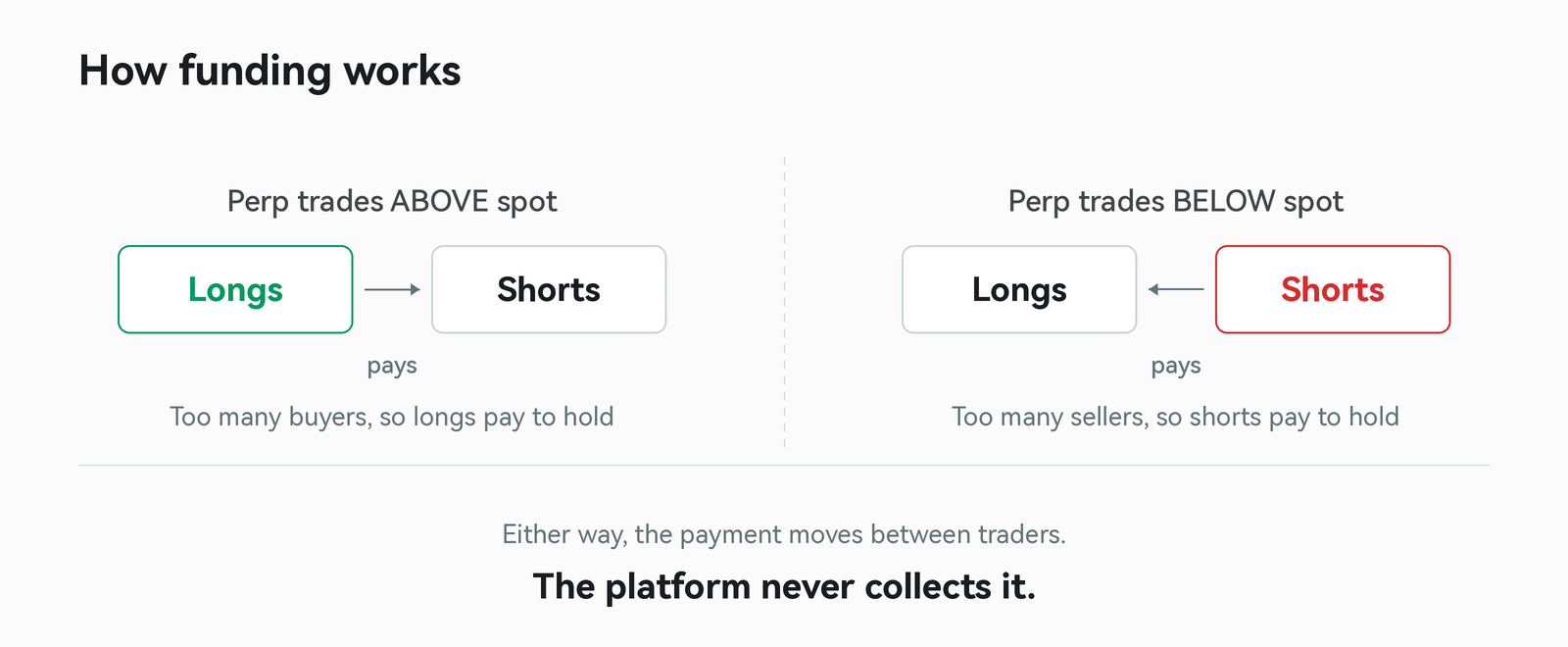
Think of it like a seesaw. When too many traders pile onto the "long" side (betting the price goes up), the funding rate tips in favor of the "short" side, and longs start paying shorts to balance things out. When too many pile onto "short," it flips. The payment always flows between traders, not to the platform.
Why Does Funding Exist?
Without funding, a perpetual contract's price could drift away from the real market price and just stay there. Funding gives traders a financial reason to correct that drift themselves. If the price gets too far out of line, someone is now being paid to trade it back into place.
It's a clever fix for a real problem. The issue isn't that funding exists. The issue is how unpredictable it's allowed to become.
Why the Cost Is So Hard to Predict
Most funding rates recalculate every few hours, and they react directly to short-term sentiment. That means your cost can spike based on what everyone else is doing, not just your own position.
In a crowded, one-sided market, funding can climb into the double or even triple digits when measured as a yearly rate, and there is often no limit stopping it. It can stay elevated for days or weeks.
Here's what that looks like in real dollars. Say you hold a $50,000 leveraged position - that's the full contract size, not the margin behind it - held for six months:
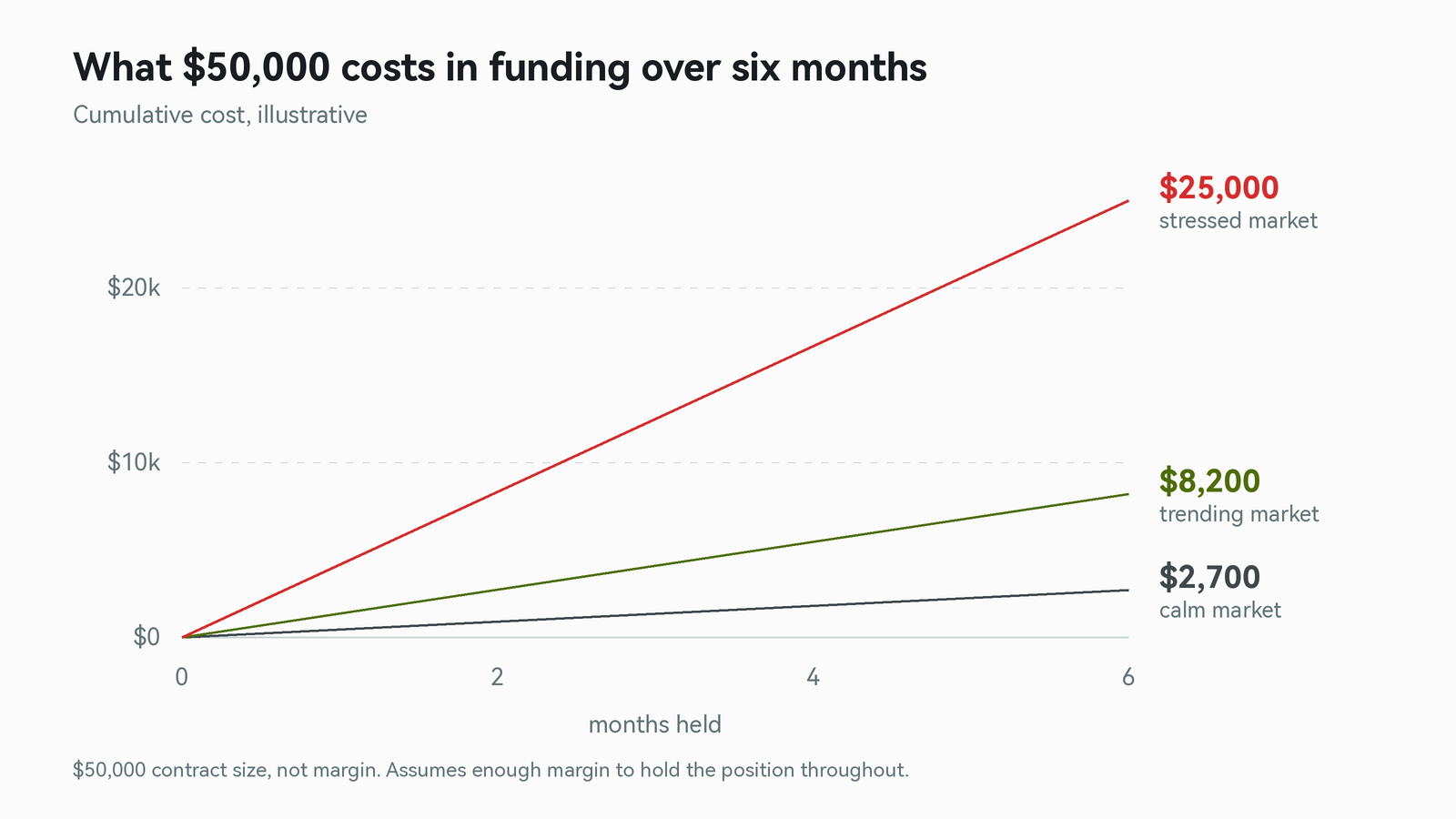
- In a calm, balanced market, funding might cost you around $2,700.
- In a trending market, that climbs to roughly $8,200.
- In a genuinely crowded, stressed market, it can reach close to $25,000, half the value of the position, in funding alone.
Two things worth noting about that third scenario. It assumes you had the margin to survive it - at high leverage, a cost that size would have closed the position long before six months were up. And nobody chooses that number on purpose. Traders arrive at it gradually, one charge at a time, often without realising how much it's adding up until they check the total.
This isn't a rare edge case either. In a survey of 134 active traders, 79% said they disliked how funding currently works. Over half, 56%, said they had actually closed a position early specifically because of funding cost. Two in three, 67%, could describe a specific bad experience with it.
Why It Matters More the Longer You Hold
Funding is often treated as a footnote, something only day traders need to worry about. That's backwards.
If you're in and out of a trade within a few hours, funding barely touches you. But if you're holding a position for weeks or months because you believe in it, funding has time to compound, and time to find you during a bad stretch. The longer you hold, the more exposed you are to a mechanism that was actually built to fix minute-by-minute price gaps, not to price a multi-month bet.
This is becoming a bigger issue as leveraged trading expands beyond crypto into real-world assets like stocks, commodities, and currencies. Leveraged trading volume on these real-world-asset contracts hit $524.8 billion in the first quarter of 2026 alone, more than all of 2025 combined.
A trader taking a leveraged, multi-month position on a stock they believe in is exactly the person this funding problem hits hardest, and exactly the person driving this growth.
What Traders Actually Want
When traders were asked to choose between today's model and a version with a predictable, capped daily rate, they picked the predictable version - both when asked directly, and when their actual behaviour was examined separately.
The takeaway isn't that traders want funding gone. It's that they want to know the number before they commit to a trade, not after.
Where Grvt Stands Today
Grvt's perpetual markets currently use a standard funding mechanism, like most venues. The problem described above is one we're exposed to as well.
What we're building is a different design for it. Stable Funding Perps will apply a capped, once-a-day funding rate on leveraged real-world asset exposure - a number you can see before you enter rather than discover afterwards.
We'll publish the mechanics in full when once it goes live.
The Bottom Line
Funding is not a rounding error. It's a real, ongoing cost, and it scales with how long you hold a position. If you trade with leverage for more than a few hours at a time, it deserves the same attention you give to the trade itself.
The fix isn't to avoid leveraged positions. It's to know what they cost before you open them.
Frequently Asked Questions
Is a funding rate a fee charged by the exchange? No. Funding is a payment exchanged directly between traders holding opposite positions. The platform facilitates it but doesn't collect it.
Can funding rates be negative? Yes. When more traders are short than long, the payment flows the other way, and short positions pay long positions instead.
How often is funding charged? It depends on the platform. Many charge every few hours; some charge once a day. The more frequent the recalculation, the more it can react to short-term price swings.
Does funding only matter for short-term traders? No, the opposite is true. Short-term traders are exposed to funding for a few hours at a time. Long-term holders are exposed for weeks or months, giving cost more time to build up.
Is there a way to know funding costs in advance? On most standard perpetual platforms, no, the rate can change with market conditions. Some newer designs, including Grvt's Stable Funding Perps, are built specifically to cap the rate so it's knowable in advance.