Where Grvt Goes Next
Onchain wealth management isn't a coming shift. The institutional assets are already here. What's missing is the infrastructure to make them composable, liquid, and accessible to anyone from $1.


Finance is moving onchain. So are users.
Settlement, custody, and issuance are cheaper, faster, and programmable onchain. Every major asset issuer, from BlackRock to Apollo, is issuing tokenized funds onchain. At the same time, global equities — including Tesla, Nvidia, Hynix — are being tokenized and brought onto public ledgers for the first time. The supply is onchain. The capital is onchain. But there is no storefront connecting them for the people already here. In particular, tokenized funds sit behind six-figure minimums with no retail distribution without a venue with real depth to trade them. And the users who want both are arriving fast: fiat on-ramps, stablecoin payroll, card off-ramps, and neobank integrations are collapsing the friction between bank accounts and wallets.
These users want what anyone wants from their money: earn steady yield on what they have, invest in trusted funds and let it compound, and trade global markets when opportunities appear. Most want some combination of all three, and none of them want their capital sitting idle between decisions.
Today they get none of it in one place. Savings sit in bank deposits or DeFi at 2–4%. Institutional investments are gated by $100K–$1M minimums and 6–48 month lockups. Tokenized stocks are listed on a handful of venues with thin liquidity and no hedging infrastructure underneath. And even when you can access these assets, they remain siloed. The composability that should make onchain finance powerful is still missing. For example, you can’t use a tokenized treasury as margin or earn yield on your equity position while holding it.
Grvt brings together what today lives in separate places, earning, investing, and trading global markets with every position composable as collateral on crypto rails. This is what we are building, and this letter explains why.
The Products Are Here. The Access Isn’t.
Every major institutional name has arrived onchain. BlackRock, Apollo, Franklin Templeton, Janus Henderson and many more. The shelf that wealth clients have trusted for decades is now on a public ledger: $24 billion in tokenized RWAs on Ethereum today, up from $5 billion eighteen months ago. Boston Consulting Group projects that figure will reach $16 trillion by 2030.
The supply is here. The challenge is making it accessible, liquid, and productive for the people already onchain.
BlackRock BUIDL requires $5M and qualified purchaser status. Apollo ACRED requires $50K and accreditation. On Grvt, similar institutional-grade yield, State Street, Mirae Asset, Baillie Gifford, Apollo, will be available from $1 with no accreditation. When a trading opportunity appears, capital doesn’t have to be unwound from yield positions just to act on it.
Over $321 billion sits in stablecoins onchain today, held for trading, hedging, savings, remittances, and most of it earns nothing. Right now the choices are: park in a stablecoin at 4%, participate in fragmented lending protocols, or take 100x leverage on a perpetual. There is very little in between. For most users, building a real portfolio onchain still means converting back to fiat or stitching together multiple protocols across different chains.
Why Yield Alone Isn’t Enough
When we surveyed users on what would actually move their capital, 60% chose a trusted vault at 8% over an unknown one at 11%. The yield number matters less than the credibility behind it. Users are not simply chasing the highest return. They also want immediate liquidity, and confidence they can exit when needed.
That insight changes the competitive landscape. Infrastructure companies like Centrifuge, Securitize, and Superstate are making tokenized funds freely transferable and tradable on secondary markets. Any onchain venue will soon be able to list a tokenized BlackRock or Apollo product. Yield alone is commoditizing. But accessibility, and liquidity are not. For retail users, what matters is what the asset can do once it lands on a platform, whether it earns, whether it’s liquid, and whether it can work as collateral across the rest of their portfolio.
Grvt’s moat is composability paired with accessibility, institutional assets that are productive from a single balance, liquid at all times, and open from $1.
The platform that wins onchain wealth management will be the one that turns every asset into working collateral, usable across everything at once.
What We Spent Three Years Building
We started from the hardest problem.
A perpetual DEX requires institutional matching speed, real time risk management across thousands of simultaneous positions, settlement provable to Ethereum without a trusted intermediary, and user custody maintained throughout.
We built a matching engine running at institutional-grade speed [confirm exact TPS/latency with Aaron], co-designed with Ampersan, a team of former institutional market makers who are also Grvt equity partners. Underneath sits ZK Atlas, our settlement layer, which proves every position to Ethereum while keeping assets in user custody throughout.

The system has been running in production for over 480 days.
We discovered that trading paired with yield is a very strong retention and acquisition lever. When we launched Earn on Equity, enabling trading collateral to earn up to 11% APY while remaining tradable, referral conversion rose from 7% to 45%. TVL grew 5x, retention doubled, and the $1M+ volume cohort expanded 16x. Distribution spend dropped too.
Users most sensitive to capital efficiency are also the highest-value users. Composability self-selects for them. They come in for yield, stay because their capital works as margin, and refer others because the experience matches how they already manage money. When your vault position doubles as trading margin, you never have to choose between earning and acting. A macro event hits, you trade on it immediately, and your yield keeps compounding underneath. That’s why users stay. And that’s why asset issuers want to be on Grvt, capital that’s productive in multiple ways at once doesn’t leave when markets get volatile. So, we decided that every new product we ship, fixed yield or branded investments, is composable from day one. Each one brings in more users and keeps the best ones around longer.
The perpetual DEX was always the first building block, the hardest one.
The liquidity infrastructure we built for crypto perpetuals is now expanding to tokenized stocks and RWA markets.
From day one, running a perp DEX at institutional speed required us to solve orderbook depth and liquidity. We built GLP, our liquidity infrastructure that could provide tight, continuous spreads on every pair we list. Expanding that same infrastructure to hundreds of tokenized equities means adopting an enhanced hedging model: what we call a synthetic brokerage flow where GLP hedges directly through traditional finance venues, similar to how Tradfi retail brokerages operate today. This is already in the works, building across both spot and perpetual markets. The liquidity for tokenized stocks will be routed through the same global markets these assets already trade on.
We built the rails for crypto first, starting from crypto perps, expanding to crypto spot, and now extending to tokenized equities and RWA products, learning from our experience along the way as the market evolves, all on top of the same technology. The matching engine handles the speed. The GLP infrastructure handles the liquidity. And the composability engine makes every asset productive the moment it lands on the platform.
How It Works in Practice
Composability is the core architecture of Grvt. Everything below is what it produces when paired with the right assets.
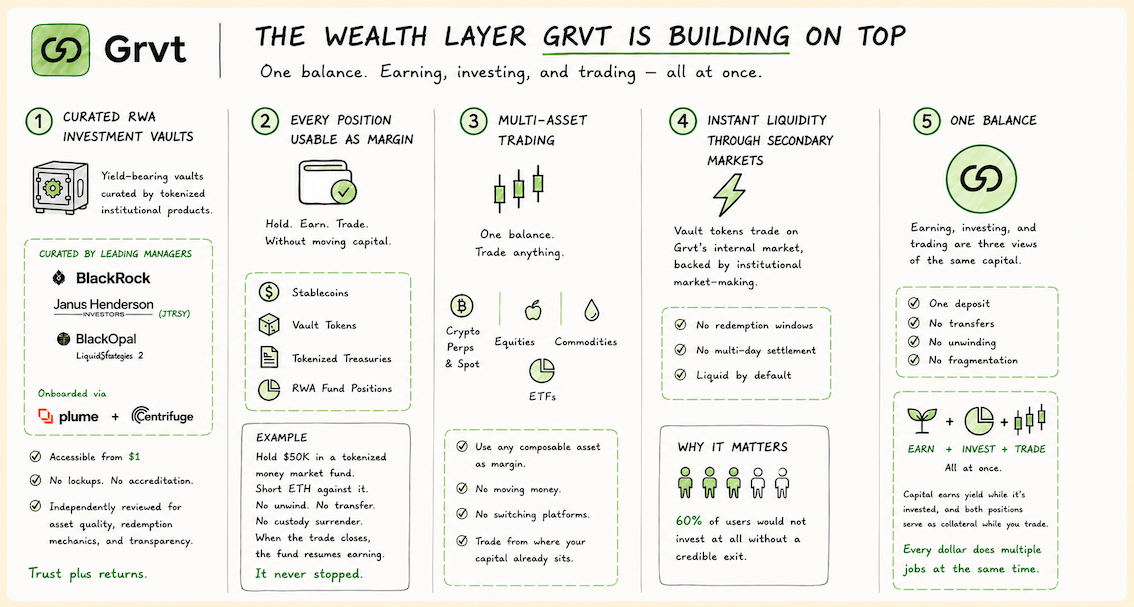
Curated RWA vaults. Live in June through Plume and Centrifuge. Every deposit earns by default: a base vault backed by institutional RWA assets delivers around 3.5% APY, so capital is never idle before a user makes an active choice. Alongside it, separate curated vaults each hold a distinct pool of institutional assets independently reviewed for asset quality, redemption mechanics, and onchain transparency, including:
● BlackRock AAA CLO exposure at around 4.6% APY,
● Janus Henderson treasuries at around 3.3% APY,
● BlackOperal credit at around 12% APY,
Accessible from $1, no accreditation required, no lockups.
Stackable yield. The vault earns its blended institutional yield. That is the first layer. Because the vault token is composable on Grvt, it simultaneously serves as margin collateral while it keeps earning. That is the second layer. A user with $50,000 in the vault earns the blended RWA return on the full position and can trade against it as collateral without unwinding. On Grvt, the same asset earns yield, serves as trading collateral, and trades on secondary markets for instant liquidity, all at the same time.
Instant liquidity. Vault tokens trade on Grvt's internal secondary market with institutional market makers. No redemption windows. No multi day settlement delays. If a user wants liquidity, they sell.
Multi asset trading. The same collateral layer powers crypto perpetuals, tokenized equities, and commodities including gold, silver, and oil. Vault tokens serve as margin across the system. Capital moves once and works everywhere.
Tokenized stock liquidity. Grvt lists 43 equity perps pairs today, with hundreds more tokenized stocks in the near-term pipeline. Each pair is backed by real hedging depth, GLP’s synthetic broker model will route through traditional finance venues, to offer tradfi level liquidity on tokenized.
One balance. Earning, investing, and trading are three views of the same capital. One deposit, no transfers, every dollar doing every job at once.
Where We Are Headed
When we launched the composable yield experiment on the perp DEX, our highest-value users told usthrough their behavior that they wanted their money working at all times. At the same time, institutional products from BlackRock, Apollo, and others arrived onchain in tokenized form, looking for retail distribution. The demand from our users and the supply of institutional products showed up at the same time. That is why we are building the wealth layer on top of our trading infrastructure.
What makes Grvt different is that optionality is built into the product itself. Your yield accumulates by default. Your vault positions double as trading margin. You don’t have to choose between earning and acting, the same dollar does both. We believe this is what retail investors will come to expect, and that platforms still forcing users to choose will lose them.
RWA vaults launch in June. Equity trading is live with 43 pairs today and hundreds more tokenized stocks across both perps and spot in the near-term pipeline. The mobile app is live and the wealth experience is coming to it next. Every new product we add strengthens the rest, more assets bring more users, more users bring deeper liquidity, and the whole system compounds.
Before Schwab, buying a stock meant calling a broker and paying $50 per trade. Schwab cut that to $5 and built discount brokerage as a category ,suddenly millions of people could invest directly. Before Robinhood, you still needed a desktop and a funded brokerage account. Robinhood put zero-fee trading on a phone and a generation started investing for the first time. Neither company invented the underlying assets. They changed who could access them, how fast, and at what cost. The behavior followed, and the category was named after the fact.
We think onchain wealth management is the same kind of shift. The institutional products already exist onchain. What’s missing is a platform that makes them composable, liquid, and accessible from $1, in user custody, without intermediaries deciding when capital can move. We are building for a future where someone in Jakarta, Seoul, or São Paulo holds the same institutional assets as a family office anywhere in the world. From $1. With instant liquidity. While earning and trading on the same balance.
If you have been with us through the perpetual DEX chapter, thank you. The next pieces are already shipping. Stay close.
Follow @grvt_io for what ships next.
Hong Yea, Cofounder and CEO of Grvt