Inside Grvt’s Yield Layer
The Grvt Yield Layer transforms idle capital into productive assets by seamlessly deploying funds into trusted DeFi protocols like Aave. It delivers automated yield, near-instant withdrawals, and uncompromising security.

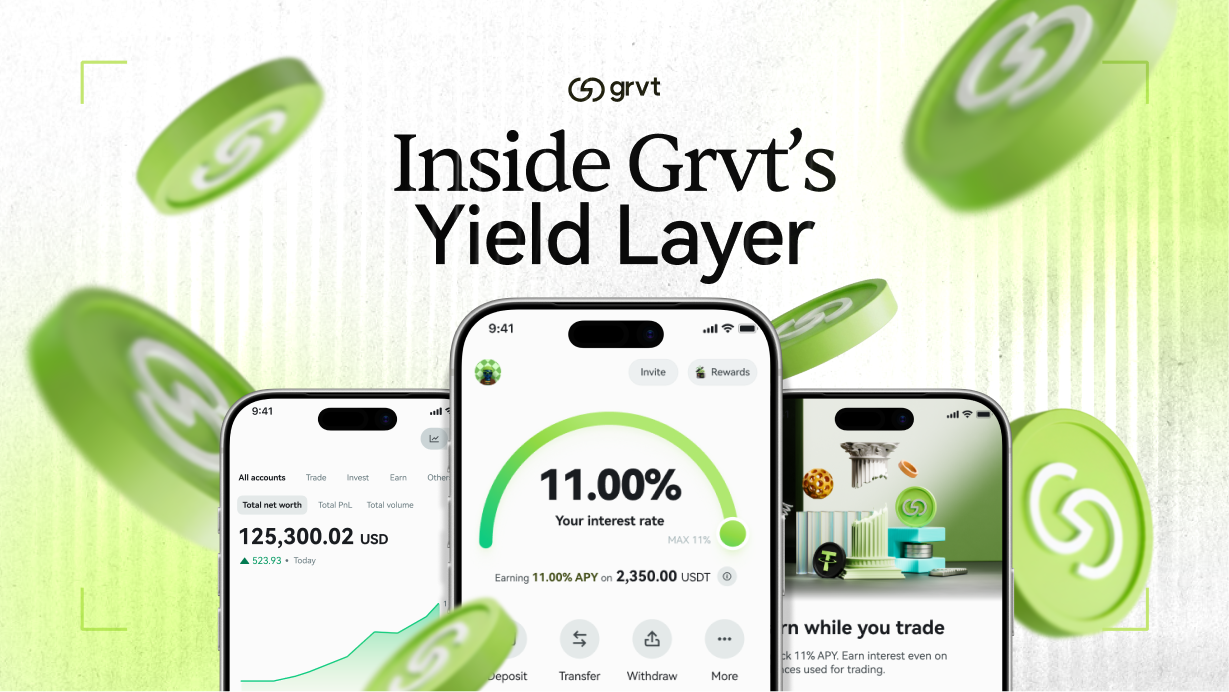
At Grvt, our vision is predicated on a simple but powerful principle: capital must remain continuously in motion to achieve maximum efficiency. Idle assets represent missed opportunities. Building on our recent announcement of the upcoming integration with Aave protocol, today we want to unpack the underlying mechanics of the infrastructure that makes this integration possible, also known as the Grvt Yield Layer.
We engineered this system to solve a critical challenge: automating idle capital deployment for maximum yield without introducing friction. Crucially, the Yield Layer delivers this seamless user experience while maintaining rigorous security standards and preserving absolute, non-custodial asset sovereignty for our users.
How the Grvt Yield Layer works
To understand the Yield Layer, you have to look under the hood at how Grvt manages its architecture.
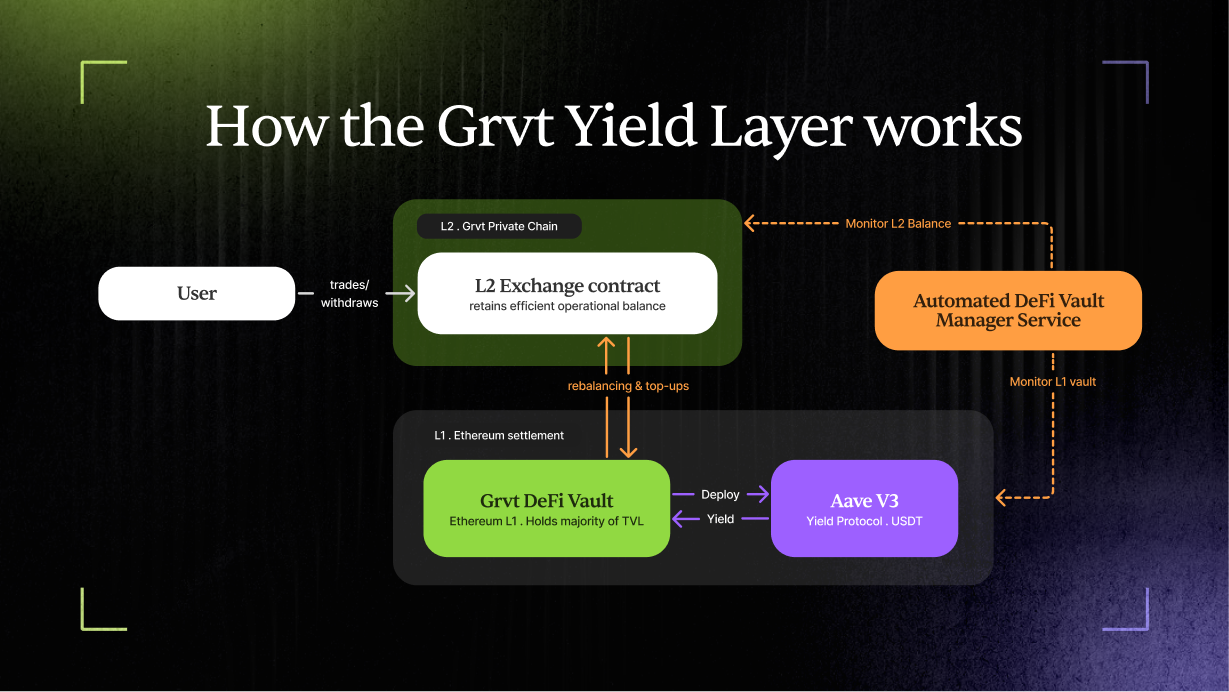
Our exchange operates across two layers: Ethereum (L1) as the settlement layer, and Grvt's validium private chain (L2) where your trades happen in real time.
Previously, the platform's TVL sat dormant inside ZKSync's native vault contract on L1. With the introduction of the Yield Layer, we will deploy a new smart contract: the Grvt DeFi Vault.
This vault acts as an intelligent bridge. Instead of letting the L1 collateral gather dust, the smart contract automatically deploys them into trusted L1 DeFi protocols to earn yield.
With the Yield Layer, the architecture evolves as follows:
- Most TVL moves into the Grvt DeFi Vault, from where it is deployed into L1 protocols (e.g. Aave) to earn yield.
- The L2 trading contract retains an efficient operational balance, enough for day-to-day withdrawals.
- An automated DeFi Vault Manager Service continuously monitors balance levels across both layers and rebalances funds to keep things running smoothly.
What Happens When You Want to Withdraw?
Capital efficiency is great, but user access to funds is paramount. So, how does the Yield Layer affect withdrawals?
Most withdrawals now take place outside of Ethereum L1 on our supported chains (e.g. Arbitrum). For all these withdrawals, operations remain near-instant via our bridging partners.
For withdrawals to Ethereum L1, the vast majority of operations will remain near-instant. The L2 chain will have sufficient operational funds to cover the request, seamlessly transferring your assets from L2 to L1 and finalizing automatically.
In rare cases of high demand, a very large withdrawal request might temporarily exceed the L2 operational balance. If this happens, your withdrawal isn't rejected. It simply enters a short, automated queue:
- Your withdrawal is accepted and confirmed immediately. Your funds are hard-reserved at that exact moment.
- The request enters a First-In, First-Out (FIFO) queue with a strict 2 hours enforced deadline.
- The automated system triggers a top-up from the L1 vault, moves the funds to L2, and clears the queue.
Your withdrawal is programmatically guaranteed. We’ve even implemented a fail-safe chain halt mechanism: the chain will literally pause to resolve the queue rather than miss a withdrawal deadline. You might notice a slightly longer processing time in these rare instances, but your finalization is absolute.
Uncompromising Security
Integrating with DeFi requires a cautious and security centric approach. We didn't just build a bridge to DeFi protocols; we’ve also built a fortress around it. The Yield Layer operates under three strict security pillars:
- Strict Whitelisting: The Grvt Vault Administrator must explicitly approve any yield protocol before a single cent is deployed. There are no rogue, untested integrations.
- Absolute Fund Isolation: The L1 DeFi Vault is hardcoded to only move funds between the L2 Exchange Contract and approved yield protocols. It is programmatically impossible for the vault to send user funds to an arbitrary external address.
- Global Pause Mechanism: In the event of extreme market volatility or an anomaly, authorized administrators can instantly hit the brakes and stop all new capital allocations. Importantly, this pause never blocks our ability to pull funds back to safety.
Ethereum Alignment and Synergy
Hosting over $166B in DeFi TVL and a stablecoin supply exceeding $200B, Ethereum represents the deepest, most concentrated pool of on-chain liquidity in existence. Grvt Yield Layer architecture is perfectly aligned to synergize with this massive ecosystem.
Every blue-chip protocol, whether it's Aave, Morpho, Pendle, Ethena, or major stablecoin issuers, represents an accessible market surface that Grvt can tap into directly.
By building and maintaining risk-assessed integrations with these industry giants, the Yield Layer transforms Ethereum's fragmented yield opportunities into a single, cohesive experience. As these integrations compound, Grvt effectively becomes the ultimate utility layer, allowing our users to effortlessly tap into the highest DeFi liquidity available, all from one secure balance.
An Exchange architecture designed to pay you
The Grvt Yield Layer represents another step forward in building our exchange infrastructure to make sure it pays you. By safely putting idle capital to work do you, we are building a more robust, sustainable, and efficient platform for all our users, without compromising a single ounce of the speed and security you rely on.
Read the detailed FAQ here: https://help.grvt.io/en/articles/14107072-grvt-yield-layer