Is Perp DEX Safe? The Ultimate User Guide to Perpetual DEX Security (2026)
Is perp DEX safe? The answer depends on the platform and on understanding which risks actually matter. From smart contract exploits to oracle manipulation and liquidation cascades, this guide breaks down the real security landscape and what to check before you trade.
Perpetual DEXs processed over $1 trillion in monthly volume for the first time in late 2025. Tens of thousands of traders have moved their derivatives activity on-chain. And yet the question that every serious trader asks before depositing a single dollar remains the same: is perp DEX safe actually?
The answer is not a simple yes or no. It depends on what you mean by "safe," which risks you're most exposed to, and critically, how the platform you're using is built. This guide cuts through the noise. We'll cover the real risks of trading on a perp DEX, where perp DEXs are genuinely safer than centralized alternatives, and the specific architecture choices that separate high-trust platforms from high-risk ones.
First, Some Context: Why Traders Are Moving On-Chain
Before answering whether a perp DEX is safe, it helps to understand why traders moved on-chain in the first place. The FTX collapse in November 2022 wiped out billions in customer funds. $8 billion in deposits had been secretly transferred to FTX's affiliated trading firm and lost. The Bybit hack in February 2025 stole $1.4 billion from the world's second-largest derivatives exchange through a compromised multi-signature wallet interface. Both were custodial failures, risks that don't exist on a self-custodial perp DEX where your collateral never leaves a smart contract you can verify.
That doesn't mean perp DEXs are risk-free. It means the risks are different and more transparent.
The 5 Real Risks of Trading on a Perp DEX
1. Smart Contract Exploits
Every perp DEX runs on smart contracts, self-executing code that manages your collateral, leverage, liquidations, and payouts. If that code has a flaw, an attacker can exploit it to drain funds. This is the most fundamental risk in on-chain trading.
It happened to GMX in July 2025, when a reentrancy vulnerability in its order book contract allowed an attacker to withdraw approximately $42 million. It happened to KiloEx in April 2025, when a multi-chain attack drained nearly $7 million across BNB, Base, and Taiko networks. Smart contract exploits don't require hacking a server or stealing credentials. They exploit the logic of the code itself.
The most common smart contract vulnerabilities include reentrancy bugs, math and rounding errors in leverage calculations, and unprotected admin functions, flaws that are often invisible until exploited. This is why audit depth matters more than audit count.
What to look for: Platforms with multiple independent audits from reputable firms (Trail of Bits, Certik, Hacken, Quantstamp), active bug bounty programs, and a track record of clean security reviews. Audits don't guarantee safety, but their absence is a serious red flag.
Grvt has undergone multiple independent smart contract audits. Reports are publicly accessible, and all critical findings have been remediated prior to mainnet launch.
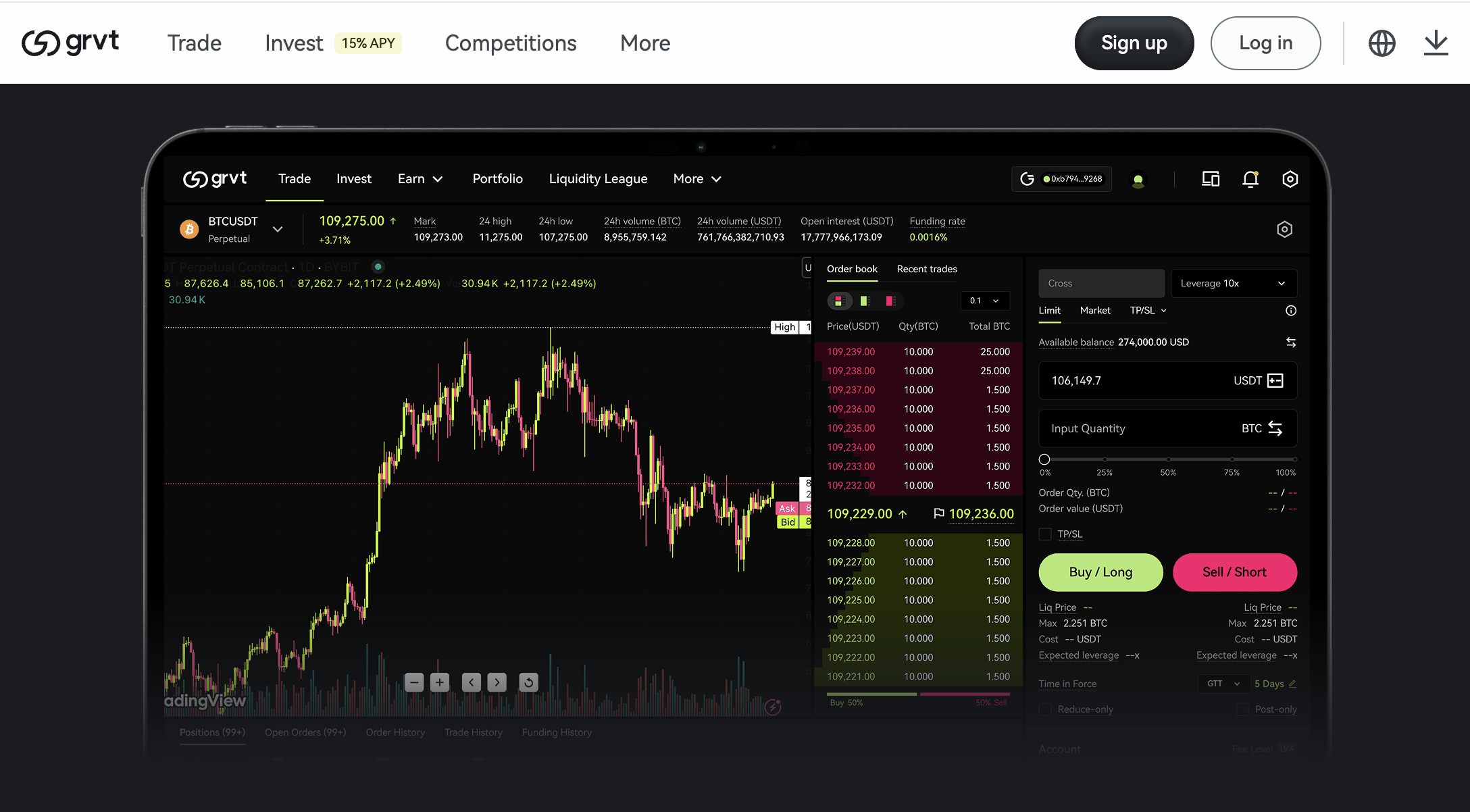
If you want to trade on a secure, audited perp DEX that feels immediately familiar, explore Grvt to to experience its clean order entry, full depth visibility, and institutional-grade execution, all in a self-custody environment.
2. Oracle Manipulation
Perp DEXs rely on price oracles, external data feeds that tell the protocol what an asset is worth. Oracles power everything: mark prices, funding rates, liquidation triggers. If an oracle is manipulated, the consequences cascade instantly across every open position.
An attacker who briefly distorts the price of an asset can trigger mass liquidations, drain the insurance fund, and extract value from the protocol before the price corrects. This is especially dangerous on perp platforms because leverage amplifies the effect of even small price deviations. Flags including using of single-source price feeds and on-chain manipulation via flash loans, which are two most exploited oracle weaknesses in perp DEX protocols.
What to look for: Platforms using multiple independent oracle providers (Chainlink, Pyth, Redstone) rather than a single source, with circuit breakers that pause liquidations during abnormal price movements.
3. Front-End Attacks
A front-end attack doesn't touch the smart contract at all. Instead, an attacker compromises the website or user interface to redirect fund approvals to a malicious address. The user signs what appears to be a normal transaction, and sends their funds to an attacker.
This attack vector is growing. A recent $1.5 billion crypto theft was attributed in part to front-end manipulation. It's particularly dangerous because it bypasses all smart contract security entirely.
What to look for: Always verify the contract address you're approving before signing. Use bookmarked URLs rather than clicking links. Platforms with open-source frontends and reproducible builds give users a way to verify what they're interacting with.
4. MEV and Front-Running
In most transparent-mempool blockchains, your transaction is publicly visible before it's confirmed. Sophisticated actors such as MEV bots and searchers scan the mempool for large trades, liquidation events, and position openings, then insert their own transactions ahead of yours to profit at your expense. This is called Maximal Extractable Value (MEV), and it costs perp traders real money on every trade.
Front-running is particularly damaging in perp markets: a bot that sees a large liquidation before it executes can position ahead of it, worsening the price impact and effectively extracting value from the liquidated trader.
What to look for: Platforms that use private mempools, encrypted order submission, or zero-knowledge proof architecture to prevent transaction visibility before confirmation. These are rarer but represent the highest standard of execution fairness. Grvt's ZK-proof architecture means no trade is ever broadcast to a public mempool. Front-running and MEV extraction are structurally impossible, not just mitigated.
Read more about Grvt’s Security Stack
5. Liquidation and Auto-Deleveraging Risk
Leverage is the defining feature of perp trading and the defining source of additional risk. When the market moves against a leveraged position and margin falls below the maintenance threshold, the platform liquidates the position to protect the protocol's solvency.
In extreme market conditions, liquidations can cascade. The October 2025 market crash triggered over $5 billion in liquidations in a single session, overwhelming insurance funds on multiple platforms. Some platforms responded with Auto-Deleveraging (ADL), forcibly closing profitable positions to offset losses from the other side. Traders who had winning short positions saw them closed involuntarily.
What to look for: A well-capitalized insurance fund with publicly visible reserves, transparent ADL policies, and a liquidation engine designed to handle market stress without socializing losses onto profitable traders. Grvt processes over $41 billion in monthly perp volume (averaging $1.5 billion per day) backed by institutional market makers including Flow Traders, Amber Group, and IMC, providing the order book depth that keeps liquidation cascades contained even under extreme volatility.
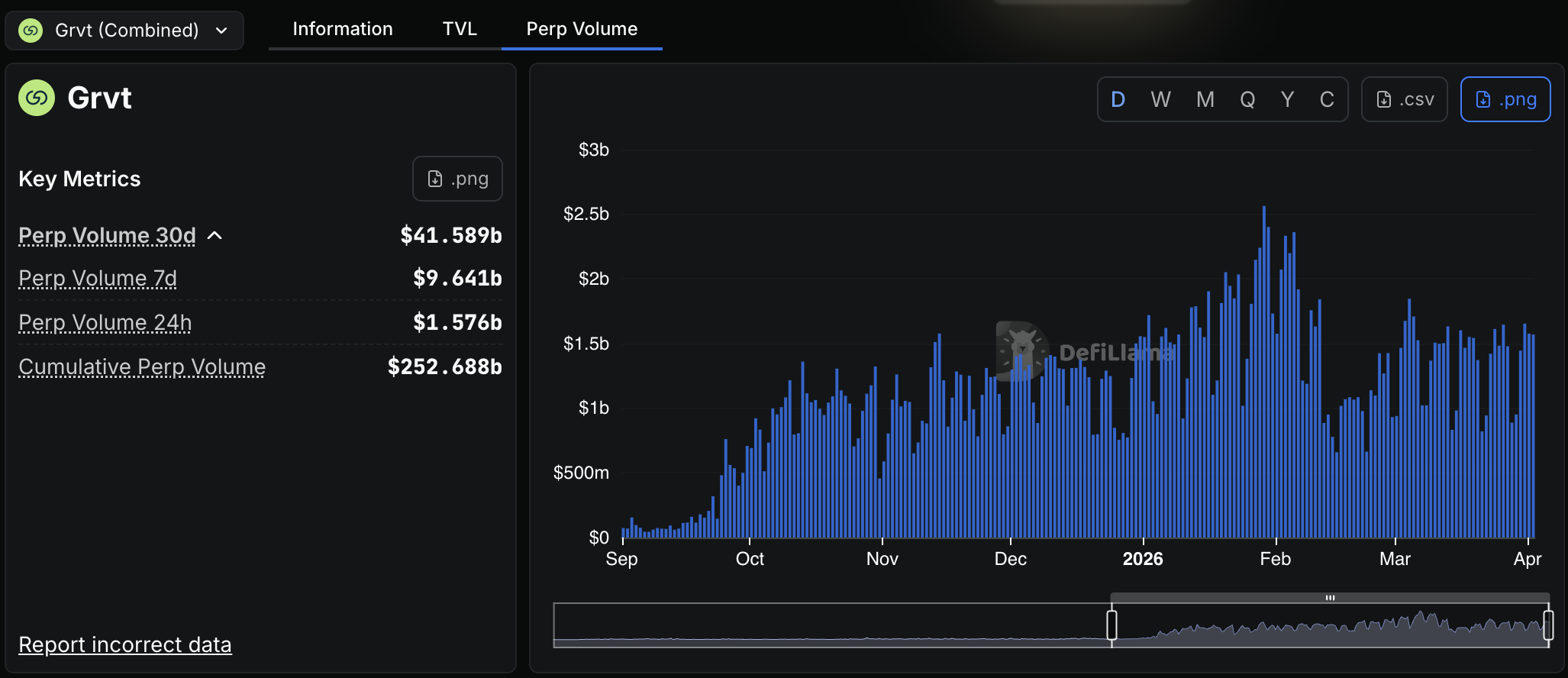
Volume data is publicly verifiable on DeFiLlama.
Is Perp DEX Safer Than CEX
The risks above are real. But it would be misleading to present them without acknowledging the structural ways perp DEXs are genuinely safer than their centralized counterparts.
Self-custody eliminates custodial risk. On a perp DEX, your collateral is held in a smart contract, not on an exchange's balance sheet. The exchange cannot lose your funds through mismanagement, fraud, or operational failure. The $1.4 billion Bybit hack and the $8 billion FTX collapse were both custodial failures. Neither could happen on a self-custodial perp DEX.
On-chain transparency enables independent verification. Every trade, liquidation, funding payment, and insurance fund movement is recorded on a public blockchain. You don't have to trust the platform's published reports. You can verify the state of the protocol yourself at any time. CEXs offer no equivalent transparency.
No single point of operational failure. CEX infrastructure, servers, APIs, custody systems, creates concentrated targets. A single compromised server can halt withdrawals, freeze accounts, or expose sensitive data. Smart contract-based platforms have no equivalent central system to compromise.
What Separates a Safe Perp DEX from a Risky One
Not all perp DEXs are built equally. Architecture choices made at the protocol level determine your real exposure. Here's what to evaluate before trading.
Custody Model
Does the platform hold your funds, or do they stay in a smart contract you control? Self-custody is non-negotiable for serious traders. If the platform requires you to deposit into a centralized wallet, not a smart contract, you are reintroducing CEX-style custodial risk.
Settlement Architecture
Where and how does trade settlement happen? On-chain settlement, verifiable by anyone, is the gold standard. Some hybrid platforms execute orders off-chain for speed but settle on-chain. This is acceptable if the on-chain settlement is the source of truth for fund movements. What matters is that no trade outcome can be altered or reversed without an on-chain record.
Oracle Design
Look for platforms using multiple independent oracle providers rather than a single source, with circuit breakers that pause liquidations during abnormal price movements, and a track record of oracle stability during high-volatility market events.
Audit History
How many audits has the platform completed, and by whom? Are the audit reports publicly accessible? Have all critical and high-severity findings been remediated? An audit from a single firm, completed once at launch and never updated, provides limited assurance for a live, evolving protocol.
Insurance Fund
How large is the insurance fund relative to open interest? Is it publicly visible on-chain? Has it been depleted or strained in past market events? A healthy, transparent insurance fund is your first line of protection against socialized losses.
Upgrade Mechanism
Can the protocol's smart contracts be upgraded? By whom, and with what governance process? Upgradeable contracts can be patched for security but they also mean the protocol can change in ways that affect your funds. Understand who holds upgrade keys and what time-locks or governance votes are required.
The ZK Advantage: A New Standard for Perp DEX Security
For traders asking whether a perp DEX is safe, ZK architecture is the most compelling answer the industry has produced so far. Platforms built on ZK-rollup infrastructure like Grvt, which settles every trade on Ethereum L2 via ZK-proofs. This approach offers a security model that addresses several risks simultaneously.
Every trade is cryptographically verifiable. ZK-proof settlement means the correctness of every trade execution, margin update, and fund movement can be mathematically proven, not just trusted. You don't need to trust that Grvt processed your trade correctly because the proof is on-chain, independently verifiable by anyone.
No public mempool exposure. Grvt's ZK architecture processes transactions without broadcasting them to a public mempool before confirmation, eliminating the MEV and front-running vectors that affect transparent-chain perp DEXs entirely.
Self-custody throughout. On Grvt, your collateral never leaves a smart contract you control, not during deposits, not during active leveraged trading, not during withdrawal. There is no internal Grvt wallet holding your funds. This is what makes the platform structurally immune to the custodial failures that brought down FTX and cost Bybit $1.4 billion.
Read more about How Grvt’s Self-custodial Trading Works.
On-chain finality with off-chain speed. Grvt's hybrid CLOB model processes order matching off-chain at CEX-level speeds with over 600,000 transactions per second with millisecond latency, while settling every outcome on Ethereum L2 with ZK-proof verification. Speed and security are not traded off against each other.
A Practical Checklist Before You Trade on Any Perp DEX
Use this before depositing on any new platform. It covers the key questions that determine whether a perp DEX is safe to trade on:
- [ ] Audit status: Are there multiple independent audits? Are reports publicly accessible? Have critical findings been fixed?
- [ ] Custody model: Do your funds stay in a smart contract, or does the platform take custody?
- [ ] Settlement: Is settlement on-chain and verifiable? Is there a public record of all fund movements?
- [ ] Oracle design: Are multiple independent oracle providers used? Are there circuit breakers?
- [ ] Insurance fund: Is the fund balance publicly visible on-chain? What is its size relative to open interest?
- [ ] Bug bounty: Is there an active, well-funded bug bounty program (e.g., on Immunefi)?
- [ ] Team transparency: Is the team publicly identified? Is there a track record of incident response?
- [ ] Upgrade controls: Are contract upgrades time-locked and governance-gated? Who holds admin keys?
- [ ] Frontend verification: Can you verify the contract addresses you're approving before signing?
- [ ] Chain reliability: Has the underlying blockchain experienced significant outages? (dYdX v4's chain halt during a mass liquidation event in October 2025 is a notable example of chain-level risk)
The Bottom Line
Is perp DEX safe? Safer than a CEX for custodial risk — definitively. Safe from all risk — no.
The risks of perp DEX trading are real: smart contract exploits, oracle manipulation, MEV, cascading liquidations. But they are architecturally different from CEX risks, more transparent, and in many cases more manageable. The collapse of FTX and the Bybit hack were failures of custody and trust at the centre of the system. Smart contract exploits target individual protocols. It is damaging, but contained to the platform affected rather than wiping out an entire ecosystem in a single event.
The industry today aim to reach a consensus that “security is not a feature, it's architecture." The right question isn't "is perp DEX safe?" It's "which perp DEX is built to be as safe as possible?" The answer comes down to audits, custody architecture, oracle design, settlement verifiability, and the engineering choices made before a single trade is placed.
Those are the things worth checking before you deposit. This guide gives you the framework to do exactly that. And if you want a platform that's built to answer every item on it, Grvt is a good place to start.
Frequently Asked Questions
Can I lose all my funds on a perp DEX? Yes. Through leverage, liquidation, or a smart contract exploit. Using appropriate leverage, setting stop-losses, and choosing audited platforms with transparent insurance funds significantly reduces this risk. Never trade with funds you cannot afford to lose.
Are perp DEXs safer than CEXs? For custodial risk, yes. Your funds never leave your control on a self-custodial perp DEX. For smart contract risk, perp DEXs introduce risks that CEXs don't have. The trade-off is transparency and self-custody against protocol-level risk.
What is the biggest risk on a perp DEX? Smart contract exploits are the most commonly cited risk, but oracle manipulation and cascading liquidations have historically caused larger aggregate losses. Platform architecture, how oracles are designed and how the insurance fund is managed, matters more than any single audit.
What is a ZK perp DEX? A perp DEX that uses zero-knowledge proofs to verify and settle trades on-chain. ZK settlement provides cryptographic proof of every trade outcome, eliminates public mempool exposure (reducing MEV risk), and combines off-chain execution speed with on-chain security guarantees.
How do I verify a perp DEX's smart contract audits? Most reputable audit firms (Trail of Bits, Certik, Hacken, Quantstamp) publish full reports on their websites. The platform should link directly to these reports. Look for: scope of the audit, severity of findings, remediation status of all critical and high issues, and the date of the most recent review.
What is auto-deleveraging (ADL) and should I be concerned? ADL is a mechanism that forcibly closes profitable positions to offset losses from liquidated traders when the insurance fund is depleted. It protects protocol solvency but can close your winning positions involuntarily during extreme market events. Understand the ADL policy of any platform before opening large positions.