Closing the RWA Knowledge Gap: Grvt Takes Industry Practice Into the Classroom
The regulatory framework for real-world asset tokenization is in place. What the industry still lacks is the human layer: the executives and fund managers who understand how tokenized assets are actually traded, invested, and put to work. Grvt is helping close that gap.

The regulatory infrastructure for real-world asset tokenization is in place. Stablecoin licensing is live in Hong Kong. The SFC's virtual asset platform regime is operational. The Ensemble sandbox is running live tests on tokenized bonds, fund units, and cross-border settlement.
What is still catching up is the human layer.
The fund managers, compliance officers, and executives who will actually deploy capital into this ecosystem need to understand how these instruments work, not just that they exist. That is a gap Grvt is actively working to close. Regulation creates permission. Practitioner-led education creates capability. They are not the same thing, and right now the industry needs both.
In June 2026, Grvt Co-founder and CEO Hong Yea joined HKU (Hong Kong University) SPACE's Certificate programme on Tokenised RWA, Stablecoin and Digital Assets as a guest lecturer, bringing front-line perspective on how tokenized assets are actually distributed, traded, and put to work.
The Regulatory Moment
On 10 April 2026, the Hong Kong Monetary Authority granted the city's first stablecoin issuer licences under the Stablecoins Ordinance, which came into force in August 2025. The inaugural licensees include a joint venture of Standard Chartered, HKT, and Animoca Brands, alongside HSBC. The move formally opened a regulated stablecoin ecosystem and put Hong Kong ahead of every other major financial centre on this front.
The SFC has been building out a parallel framework for tokenized real-world assets (RWAs), with the government's Ensemble sandbox already handling tokenized bonds, fund units, and cross-border settlement infrastructure. The roadmap includes expansion into precious metals, renewable energy credits, and other asset classes as part of a broader strategy to make Hong Kong the global hub for programmable finance.
The architecture is deliberate: regulate first, build on solid ground. What the city now needs is the practitioners who can actually operate within it.
The Talent Gap
Most professionals in traditional finance understand what an asset is. Very few understand what happens to that asset once it is tokenized: how it gets distributed, how it earns yield, how it can be used as collateral, and how it trades in a composable onchain environment. That knowledge gap is not trivial. It is the gap between a regulatory framework sitting on paper and an ecosystem that actually functions.
Recognising this, HKU SPACE introduced its certified course Introduction to Tokenised RWA, Stablecoin and Digital Assets. The 30-hour programme covers blockchain fundamentals, RWA tokenization, stablecoin regulation, and digital asset security, and is taught by Thomas Ng, CEO of Wealth Management Cube. The audience is not developers. It is the executive layer that will decide whether institutions move into this space or stay on the sidelines.
What Happens After Tokenization
In June 2026, the programme welcomed Hong Yea, Co-founder and CEO of Grvt, as a guest lecturer. While most voices in the tokenization conversation represent asset issuers, fund managers, or tokenization providers, Hong brought a different angle: what happens to tokenized assets after they exist.
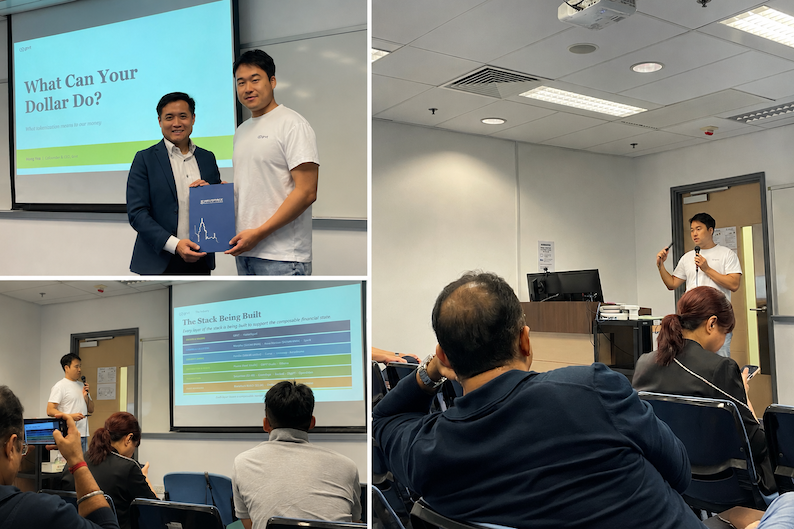
The lecture walked through how stablecoins, tokenized real-world assets, and composable financial infrastructure interact in a live trading environment. The focus was the distribution layer: wealth products, yield generation, collateralization, and active trading. This is the part of the stack that most educational programmes skip because it requires someone who is actually building and running it.
At Grvt, that distribution layer is the core product. Traders on the platform can access perpetuals on tokenized real-world assets including global equities like NVDA and SPY, commodities, and ETFs alongside crypto, all within a single composable balance. Beyond trading, users can allocate into RWA investment vaults, putting capital to work as a yield-generating asset rather than leaving it idle. The next step in the roadmap is vault tokens functioning as collateral for perp trading, a composable loop where RWA exposure earns yield and simultaneously backs active positions.
The lecture made the abstract concrete: tokenized assets are only as useful as the infrastructure built to deploy them. Distribution, yield, margin, and trading are not separate problems. They are one problem, and it is being solved onchain right now.
Building the Human Infrastructure
Hong Kong is in an unusual position. It is one of the few places in the world where regulation, market infrastructure, and education are advancing in parallel rather than sequentially. The Stablecoins Ordinance, the SFC's virtual asset licensing regime, and the Ensemble sandbox have collectively created the conditions that institutional capital requires before committing. What initiatives like the HKU SPACE programme are doing is building the human infrastructure to match.
The classroom is where the next chapter of this industry gets written. Not because theory is sufficient, but because practitioners in the room accelerate the translation from regulatory clarity to market reality.