The Growing Wealth Gap Since the Industrial Revolution
Why early financial innovations favored the rich and how to rewrite the rules


The Industrial Revolution (circa 1760–1840) permanently transformed global finance, shifting economic power from landholdings to industrial assets. New banks, stock markets, and credit instruments emerged to fund factories, railroads, and mining—kick‑starting an era of unprecedented economic growth. Yet these innovations disproportionately benefited the wealthy few, planting the seeds of today’s enduring wealth disparity.
Why Early Financial Innovations Favored Industrialists and Landowners
1. Access to Capital
- Large loans and credit lines: Early banks prioritized borrowers with substantial collateral—typically established industrialists or landowners—enabling them to expand operations and amass even more wealth.
- Elite investment networks: Stock and bond markets were dominated by affluent families who had both the funds and insider knowledge to invest wisely.
2. Ownership of Productive Assets
- Factory and machinery control: Those who owned factories reaped the lion’s share of profits from mass production and expanding consumer markets.
- Land and mineral rights: Many large landowners pivoted into industry by leasing mineral rights (coal, iron) and investing windfalls into shares—further concentrating capital.
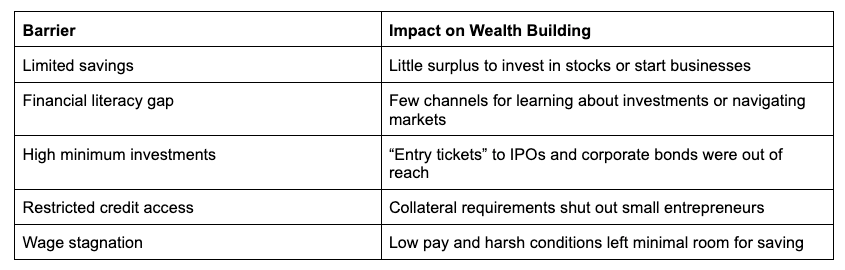
Barriers Facing the Middle Class and Working Poor
Despite the emergence of a middle class, structural roadblocks kept most from meaningful wealth accumulation.
The Legacy of Unequal Opportunity
By 1900, the richest 1% in industrializing nations controlled over half of all private wealth—setting a pattern that persists in modern capitalism. Although technology and regulation have broadened access to financial markets, systemic barriers—such as income inequality, uneven educational resources, and network effects—continue to favor those with inherited or early‑acquired capital.
Democratizing Wealth: A New Vision with Blockchain
Under modern capitalism and financial systems, wealth creation is theoretically accessible to all—but in practice, middle-class individuals, grassroots men, and those in developing or underdeveloped regions face structural and systemic barriers that often limit their ability to accumulate wealth.
Wealth creation under capitalism is often framed as a matter of personal responsibility—but access, infrastructure, and education are just as critical. Empowering people at the margins requires a multi-pronged approach that blends grassroots solutions with tech innovation, financial reform, and policy support.
Let’s rewrite the rules of wealth creation by leveraging blockchain’s transparency and accessibility.
- On‑chain marketplace: Compliant, user‑friendly platforms where anyone can buy, sell, or fractionalize assets without gatekeepers.
- Lowered entry thresholds: Tokenization lets investors participate with micro‑investments, breaking down the high minimums of traditional finance.
Verifiable trust: Smart contracts enforce transparency, reducing information asymmetry and leveling the playing field.