AMA Recap: What Recent Hacks Taught Us About On Chain Safety
DeFi security has never mattered more. In Grvt's latest community AMA, our blockchain lead and four veteran DeFi researchers broke down recent attacks, how Grvt responded to the Kelp DAO incident, and how to evaluate where you put your capital.

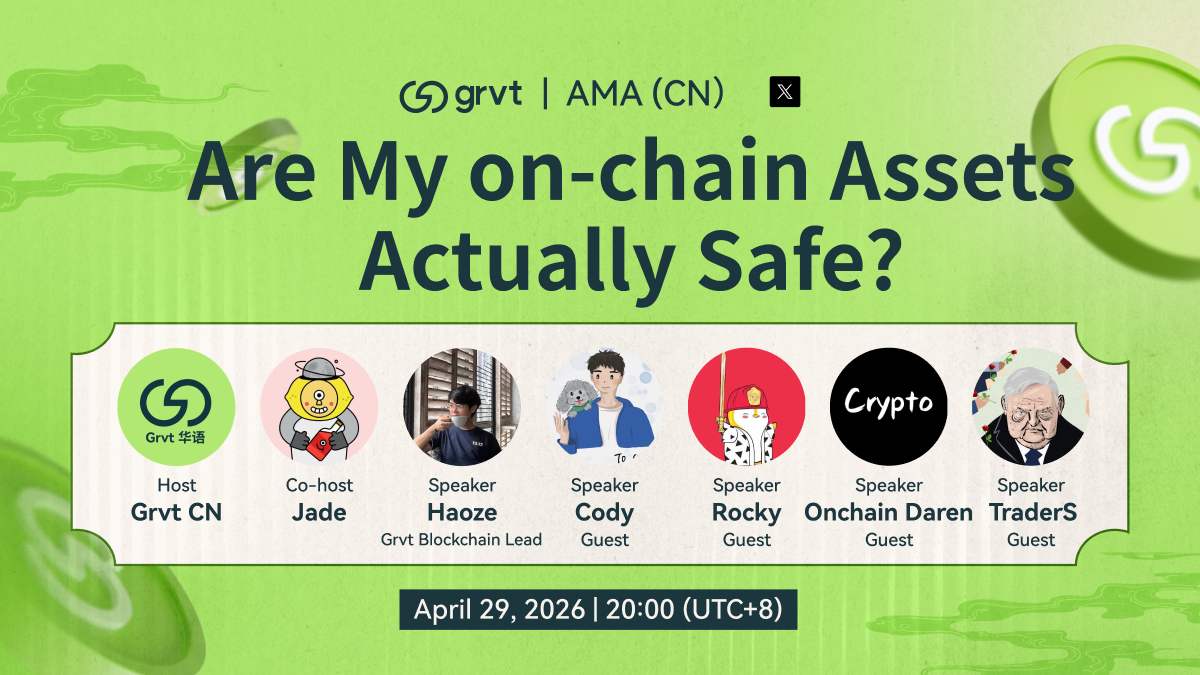
The last few months have been a stress test for on chain finance. Drift Protocol, Kelp DAO, and several legacy DeFi protocols all faced incidents that rippled across the ecosystem. Users are asking a more fundamental question than usual: are my on chain assets actually safe?
To unpack that, Grvt invited four veteran DeFi researchers and our own blockchain lead, Haoze, into a live community AMA. The goal was simple. Move past the headlines and give listeners a usable framework for judging where their capital sits.
The original AMA was conducted in Mandarin Chinese and drew 12.7k listeners.
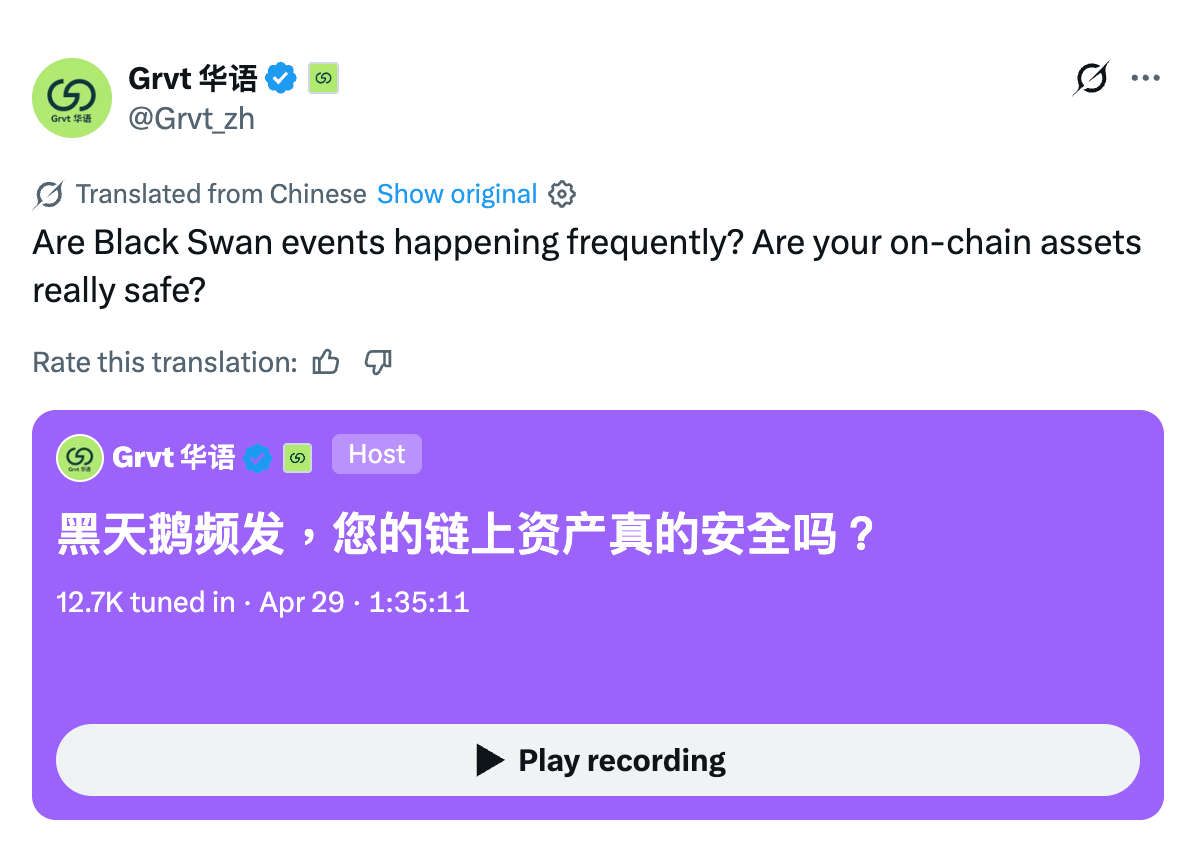
You can listen to the full session here. This recap is a translated and paraphrased summary of the key takeaways for our wider audience. The full replay in the original language will be posted on our official channels.
Host and Guests
- Jade, Content & PR at Grvt
- Haoze, blockchain engineer at Grvt
- Cody, DeFi writer with firsthand experience surviving on chain exploits
- Rocky, cofounder of Blue Ocean Capital, a Web3 secondary market fund
- On-Chain Daren, on chain power user since 2018
- TraderS, eight years across exchanges, macro, and DeFi
Where Your Money Actually Goes on Grvt
The AMA opened with the most basic question users have but rarely get answered clearly: when I deposit, where does my money live?
Haoze walked through the full path on Ethereum.
When you deposit USDT, the funds enter the ZKSync bridge and are mirrored to Grvt's Layer 2 network. Inside that L2, every contract that touches user capital is constrained by smart contract logic. Every action affecting funds requires the user's wallet signature. Grvt cannot extract those funds. This is structurally different from a centralized exchange, where deposits move under the platform's name.
Trading itself happens in a hybrid architecture. Order matching and risk checks run off chain for performance. Settlement happens on chain through ZK proofs, which compress the L2's state and verify it on Ethereum. The funds themselves never leave the bridge or the L2 contracts. Only state changes.
The yield layer sits on top of this. A portion of L2 capital can be deployed into approved DeFi protocols to earn returns, governed by the L2 and Ethereum contracts working together. Grvt acts as a manager in that flow, never a custodian.
Withdrawals settle the same way. Every step is auditable on chain.
Spotlight: How Grvt Handled the Kelp DAO Incident
This was the segment most listeners came for, and the one we want to surface clearly.
When the Kelp DAO exploit broke, Grvt's response was triggered through a designed safeguard. The yield layer was built with circuit breakers that allow capital to be recalled to Grvt's L2 contracts. That mechanism activated immediately, hours before any liquidity issues emerged in the affected pools.
Outcome: no user funds lost. No withdrawal delays.
To be clear on why this worked, the architecture matters. Capital flows through a DeFi Vault contract on Ethereum with strict directional rules baked in. The L2 contract can only release funds to that vault. The vault can only deposit into approved protocols or bridge back to the L2. Grvt manages the system. It does not custody the assets.
Haoze also broke down the root cause for listeners. The attack did not originate in Aave itself. The entry point was rsETH, a liquid restaking token, whose cross chain bridge through LayerZero was configured to require only a single validator signature. That allowed the attacker to forge a message and drain reserves. Aave had no bug of its own. But anything integrated with the affected collateral was exposed.
The lesson Haoze drew: auditing your own smart contracts is necessary but never sufficient. Every upstream dependency, including what collateral a protocol accepts and how robust its price feeds are, deserves the same scrutiny.
What's Next for the Grvt Yield Layer
Two directions came out of this experience.
Diversification across lending protocols. Aave will remain under observation and will not be re entered until conditions are clearly stable. In parallel, Grvt is evaluating other battle proven lending protocols to spread yield sources across the ecosystem. Each candidate must clear the same due diligence bar: independent audits, operational history, behavior under past stress events, and quality of accepted collateral.
Acceleration on RWA integration. Tokenized US Treasuries and money market funds are coming to the yield layer. These are anchored to traditional finance, which means their yield and safety profile is structurally decoupled from on chain volatility events like a bridge exploit or a stablecoin depeg. One non negotiable filter: any RWA partner must use a bankruptcy remote structure, where assets are held by an independent SPV and legally separated from the issuer's balance sheet.
What Our Guests Look For in a Safer Platform
Across four very different DeFi resumes, the answers converged on a short list.
Self custody as the baseline. Every guest brought this up. After FTX, "not your keys, not your coins" stopped being a slogan. Cody noted that Grvt extends self custody with extra layers, including 2FA address whitelisting and a ZK based settlement model. Rocky emphasized that Grvt's funds sitting inside ZKSync smart contracts means even the project itself cannot move user keys.
Simple beats clever. Cody recommended that newer users start with mechanically simple protocols. The more modules a protocol stacks, including borrowing, liquidity provision, complex yield primitives, the more attack surface it creates. He referenced the Juice incident, where the exploit came not from contract math but from a supply chain attack on a developer's signing environment.
Transparency without becoming a target. Rocky raised an angle that often gets missed. Full transparency cuts both ways. Hyperliquid traders have repeatedly been hunted because their positions and liquidation prices are visible, citing the Popcat squeeze and the Jelly incident. Privacy at the trading layer is itself a security feature.
The team's safety culture. This came up from every guest. Look at how the team treats audit feedback. Look at how they respond when something goes wrong. A team that ships fast and patches slowly is a yellow flag. A team that documents and responds is a green flag.
Operational hygiene. Cody shared his own setup. A dedicated machine for signing only. No GitHub pulls or dependency installs on it. URLs from bookmarks, never from search results. Cold wallets are necessary but not sufficient. Trezor was breached because the surrounding device was compromised.
How Grvt Approaches Risk Control
Haoze ran through the three biggest categories of attacks the industry has seen and how Grvt mitigates each.
Contract vulnerabilities. Every contract Grvt deploys, including the L2 contracts, the bridge proxies, and the DeFi Vault, goes through external audit before deployment. Grvt works with Spearbit. Beyond that, the most sensitive contracts run on a private chain where transactions enter only after risk engine approval. The team designs and builds as if those contracts were on a public chain anyway, so even a perimeter breach does not allow asset extraction.
Oracle and economic attacks. This is the Popcat and Jelly category. The defense is upstream of the attack itself. Grvt is conservative about which markets list, prioritizing assets with deep liquidity and large market caps where price manipulation is prohibitively expensive. Beyond listing, position size limits, paid in or out limits, and conservative margin parameters all reduce the surface for these games.
Bridge risk. The exploit pattern most listeners are worried about right now. Haoze drew an important distinction. Grvt's bridge is the ZKSync canonical bridge, a trustless bridge. To release funds, the L2 must produce a valid ZK proof of state transition. There is no validator signature threshold to game. This is fundamentally different from multisig bridges like LayerZero or Wormhole, where security is based on trust assumptions about a small set of signers. The cryptographic guarantee is what gives the model its strength.
DeFi's Trust Crisis: Headwind or Cleansing Tide?
The guests were asked whether DeFi is losing its credibility.
Rocky framed the moment as a tide pulling out, exposing what should not have been there in the first place. Lower quality protocols are getting pruned. The survivors will integrate higher standards on transparency, self custody, privacy, and increasingly compliance. RWA and institutional participation are pulling the next phase of DeFi toward more mature infrastructure.
Cody pointed to two trends he expects over the next two years. Industry level safety baselines on things like cross chain validator counts, time locks, and large transfer caps. And clearer regulatory pathways that allow compliant DeFi to inherit some of TradFi's risk control culture without losing on chain composability.
On Chain Daren made the simplest point. Every cycle has incidents. Don't avoid the space. Avoid the bad operators inside it.
TraderS closed this segment with the operational view: when something goes wrong, what matters is the team's reaction. Teams that locate the problem fast, stop the bleeding, communicate clearly, and make users whole are the ones that earn long term trust.
Haoze's view, speaking as a builder, was that the recent incidents are operational and risk control failures, not structural failures of DeFi itself. The composability and permissionless nature of DeFi are double edged. They amplify both efficiency and contagion. But every pressure event in this industry, from Luna to Wormhole to Drift, has historically pushed the surviving infrastructure to be more professional, more transparent, and more resilient. He expects the same here.
On AI and Quantum: Real or Headline?
The final question was forward looking.
The consensus across the panel: real, but not a panic.
On AI, the threat surface is shifting from contract logic to supply chain attacks and operational compromise. The defense is also shifting. AI is being used on the white hat side for continuous auditing, anomaly detection, and automated circuit breakers. Attackers and defenders both get smarter. The protocols that invest in defense in depth, including pause mechanisms, time locks, and governance hardening, will be the ones that hold up.
On quantum, the relevant attack vector is the elliptic curve signature scheme that secures most public chains today. The Ethereum Foundation has a post quantum security working group, and account abstraction is opening pathways to support quantum safe signature schemes when they are needed. Migration is a multi year engineering project, not a tomorrow morning event. And as several guests noted, even in a worst case scenario, social consensus can recover the network by migrating to a new signature scheme.
Closing
The throughline of the AMA was simple. On chain safety is not a slogan. It is a stack of decisions across architecture, risk controls, operational hygiene, and team culture. Every layer in that stack either earns trust or burns it.
Grvt's design choices, including self custody throughout, a trustless ZK bridge, the DeFi Vault structure for the yield layer, and the circuit breakers that activated during the Kelp DAO incident, are how we approach that stack. Recent events are a reminder that the work is never finished. They are also a reminder that the structural advantages of well designed DeFi are real.
Thanks to Cody, Rocky, On Chain Daren, and TraderS Daoren for joining us. Thanks to everyone who tuned in.
If a question came up during the session that you want to dig deeper into, send it to the community and we will cover it in a follow up.
Further Reading
Trade with privacy and self custody on Grvt. Open the exchange.