Vaults vs. Self-Custody: The Trust Dilemma in Modern Finance

In the world we live in today, the traditional financial system operates as a complex web of trusted third parties.
Despite its flaws, we continue to place our faith in bank vaults (digital mainly) to safeguard our money and assets. This trust stems from centuries of evolution, where the traditional banking system has established a certain level of reliability and trust in people’s minds, which is ensured (and insured) by regulations and authoritative rules of geopolitical regimes.
Unlike in the crypto world, we don’t often hear of billions of dollars being compromised at institutions like HSBC, Bank of America, or other major TradFi players. This security can be attributed to two main factors: robust security measures and stringent regulations that prevent banks from mishandling funds.
To the crypto-native world, the industry has already come a long way, weathering ups and downs, and is now gaining mainstream recognition, reaching Capitol Hill, signifying its prime time after the trading of Bitcoin and Ethereum ETFs on Wall Street commenced.
Unfortunately, “crypto” is still synonymous with scams for many, when, most of the time, what the crypto world has been perceived by the public is news around a bunch of scammers who only care about their yachts and penthouses in the Bahamas.
Given that the birth and future developments of blockchain and crypto or DeFi are never here for the crypto natives only, but for the masses, it is imperative for the industry to rethink how we can improve our image and build trust with the mainstream public.
The source of truth lies in self-custody for both retail and institutions. Its importance shall never be overstated, especially after significant compromises in crypto’s history. According to CoinDesk, $40 billion was lost through the collapse of Terra, Celsius, and FTX. Additionally, losses from crypto investment scams in the U.S. totaled $3.94 billion in 2023, according to another CoinDesk report on an FBI investigation.
In general, self-custody addresses two critical issues: trust and technological security.
A Long Way to Build Trust
Trust in the traditional banking system has been built over centuries, reinforced by regulations and security protocols. For example, in the aftermath of Silicon Valley Bank’s bankruptcy, established frameworks and measures were taken to safeguard customer losses to some extent. In contrast, crypto is still in its infancy without clear regulatory oversight, and trust has constantly been eroded by high-profile scams and failures.
In this context, self-custody offers a solution by empowering individuals and institutions to take direct control of their assets, eliminating the need for intermediaries and reducing the risk of third-party failures.
We Should Put More Faith in Technological Safety
Considering the maturity of the banking industry, there is reasonable confidence that technological advancements in crypto self-custody will evolve similarly toward a more trustworthy landscape.
Although the industry is young, it is fair to trust that current self-custodial technologies can secure assets effectively, just as how big banks protect client assets. Roughly more than 100 custodial solution providers serve institutional and retail clients in the crypto industry, according to CCData. Industry consolidation, similar to what happened in sectors like automobiles, banking, and the internet, is likely to take place in crypto’s second decade.
For retail users, hype often deters people from adopting self-custody, but self-responsibility, though relatively demanding, is essential.
Institutional-grade self-custody solutions are available and evolving, making it easier for both individuals and institutions to securely manage their assets.
Self-custody is not just a technological shift but a philosophical one. It’s about reclaiming control and ensuring trust in our financial systems. As the crypto industry matures, self-custody will become not just an option but a necessity for those who value security and trust.
A Game-Over for Current Web3 Wallets?
Web3 was intended to be trustless. GRVT is building a self-custodial centralized exchange (CEX). A key feature that distinguishes GRVT from other CEXs, is our self-custodial GRVT Wallet, powered by Dfns. GRVT is working with the leading web3 wallet infrastructure provider to address a challenge in blockchain, that is often put in the ‘too-hard basket’: private keys. The GRVT wallet is where you can easily connect to all things in web3 without getting FTX’d.
Unlike wallets used in decentralized exchanges, what sets the GRVT Wallet apart is that you take full ownership of your assets, but with a simplified user experience. It’s about defense and protection, without user complexities found in current web3 wallets. No seed phrases, less effort in key recovery, and reduced risk of theft and asset loss. Many have promised this before, but GRVT has now delivered.
Like Dfns, we recognize that there are flaws in outdated private key storage methods - from handheld hardware to written notes. Despite the purpose of decentralization in fighting against centralized control and fraud, the reality is that crypto traders are not well-equipped with easy measures to manage cryptographic keys. This has resulted in irretrievable losses due to lost or stranded wallets.
Decentralization means that you will be in full control of your assets and responsible for securing your wallet’s private keys and passwords.
Currently, you must perform burdensome tasks to manage your web3 wallet:
- Remember seed phrases
- Create and remember a strong password that the wallets cannot recover for you if lost
- Protect against scams and phishing hacks
- Always be vigilant of unknown links and software download
- Constantly do your own research
These methods are treated as standard best-practice for anyone currently engaging in crypto. However, they are exhausting even for the most seasoned users. GRVT envisions an easier world.
Crypto investors should all continue to question the difficulty of the current key management status quo. Constant stories of hacks and lost wallets reveal the struggles that even seasoned traders face. Such mistakes are even more costly for inexperienced investors, leading to increased mistrust in the crypto space, and stagnating the industry.
Action needs to be taken to resolve the issue. Leveraging the innovative solutions developed by Dfns, we built the GRVT Wallet - an entirely self-custodial wallet that removes major challenges associated with the current crypto user experience and asset security.
GRVT Wallet: Self-Custody with No Barrier
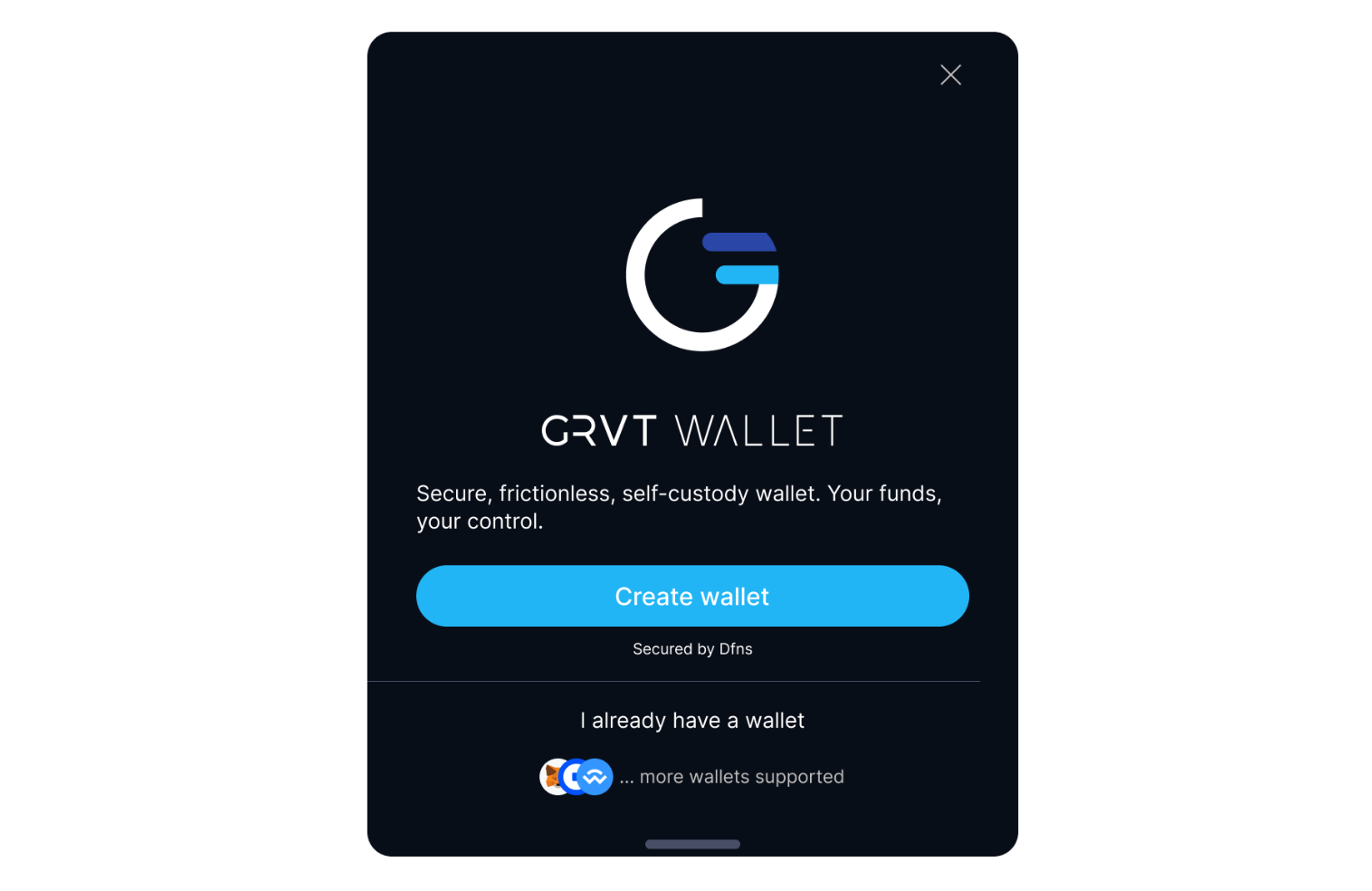
Tailored for first-time wallet users and experienced traders alike, the GRVT Wallet provides a straightforward web Authentication (WebAuthn) process: create your wallet and access it with a password and passkeys. This flow removes the complexity often associated with crypto wallets.
Dfns allows you to access your GRVT Wallet via fingerprint or facial recognition. Not only are biometrics a secure two-factor authentication (2FA) method, they are also quick, user-friendly and widely used in traditional internet banking. This streamlined approach combines the ease of web2 with asset security and self-custody.
Using Dfns technology, GRVT can leverage off-chain, permissioned peer-to-peer networks using multi-party computation (MPC) with traditional public key infrastructure. With MPC, GRVT Wallet offers these key benefits:
- No single point of failure: GRVT Wallet allows you to link to multiple devices, setting multiple security barriers against hackers.
- Responsive recovery: Various recovery options are provided, such as setting recovery wallets and generating backup codes if you lose all your credentials
- Transaction continuity: Changing your linked devices does not affect your public key or address, which Dfns uses to register and authenticate you. This ensures uninterrupted fund transfers and enhanced manageability that other wallet providers do not yet offer.
What’s more, the GRVT Wallet does not save your private key and never sends your security details to any external server. Despite being called the GRVT Wallet, it is entirely off-limits to GRVT. This safeguards your funds from server leaks and exchange risks. With the GRVT Wallet, we are laying the groundwork for simple, safe, and secure trading in the crypto world.
GRVT’s Open Beta Testnet is currently live, with more than 2.5 million users registered on waitlist. Join now for rewards from a 2.4M $ZK token pool and 600,000 raffle tickets, sign up here!
Disclaimer: Cryptocurrencies carry high risks. This content is not a distribution of, or an offer or solicitation to provide, financial services or products, nor a representation as to their suitability or legality for you. GRVT is not a regulated entity and your funds are not subject to regulatory protection. Before making any decision based on this content, please seek financial and legal advice, and carefully review GRVT’s Risk Disclosure and Disclaimer in full.