Crypto Custody Explained: Who Actually Holds Your Crypto
Crypto custody defines who can move your assets. This guide covers self custody, exchange custody, and what it means for tokenized RWAs in 2026.

Crypto custody is the single most important concept in decentralized finance and also one of the least understood. It defines who has the right to move your assets. Not who is named on the account, not what the app shows as the balance. Who can actually sign the transaction.
Users have paid expensive tuition to learn the answer the hard way. Mt Gox, Celsius, and FTX collapsed and took customer funds with them. Bybit survived its 1.5 billion dollar Lazarus Group hack in early 2025, but only because its balance sheet could absorb the loss. Every one of these events revealed the same truth: funds deposited to a custodian are only as safe as the custodian's solvency and security on any given day. The stakes are now higher. Billions of dollars of tokenized stocks, gold, treasuries, and ETFs have moved onchain in the last two years. Custody of those assets runs through the same mechanics as custody of BTC or ETH. If you do not understand the model, you do not own what you think you own.
This guide explains what crypto custody is, the two custody models every trader operates under, why tokenized real world assets have raised the stakes, and how newer exchange architectures let you hold the keys and still trade at speed.
What Is Crypto Custody?
Crypto custody is the right to move a digital asset. That right is encoded in a private key. Whoever holds the key owns the asset. Everything else is paperwork.
A private key is a long, randomly generated string of characters that acts as the signing authority for a wallet. When you want to send funds, your wallet uses the key to produce a cryptographic signature that proves the transaction was authorized by the keyholder. The blockchain verifies the signature and updates the ledger. No signature, no transfer. That is why the key is the asset. Keys are typically backed up as a seed phrase, a 12 or 24 word sequence that can regenerate the key on any device.
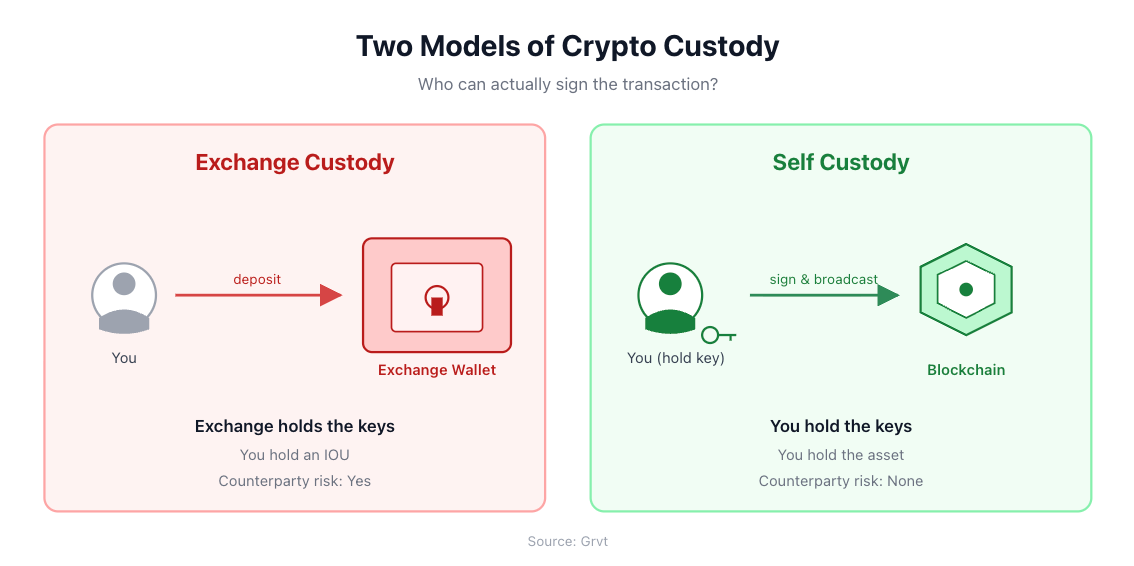
There are two ways to hold a key. A custodial model puts the key in the hands of a third party, typically an exchange, or a qualified custodian. A self custody model leaves the key on your own device.
How Exchange Custody Fails
Exchange custody fails in three predictable ways.
Operational failure. The exchange gets hacked. Bybit, one of the strongest centralized exchanges in the world, lost roughly 1.5 billion dollars of Ethereum in early 2025 when the Lazarus Group compromised a cold wallet signing flow. Bybit absorbed the loss and stayed operational. The point is that users had no say in the outcome. They were creditors betting on Bybit's balance sheet. A weaker exchange in the same position would have failed.
Corporate failure. The exchange misuses customer funds. FTX loaned customer deposits to Alameda Research. When Alameda lost the bets, there was nothing left to return. Celsius ran the same playbook on the lending side.
Regulatory or policy failure. An exchange freezes withdrawals under court order or internal risk policy. The reason does not matter to a trader who cannot exit. If the withdraw function lives with someone else, custody lives with someone else.
Every one of these failures shares a root cause. Users deposited to an address the exchange controlled. The keys left their possession. Everything downstream is a consequence of that single handoff.
Self Custody vs Exchange Custody
A self custody crypto wallet holds the private key on your device. MetaMask, Ledger, Trezor, Rabby, and dozens of others all fit the category. You control a seed phrase that regenerates the keys on any hardware.
When you sign a transaction, the wallet signs locally and broadcasts to the network. No one else touches the key. If you lose the device, the seed restores access. If you lose the seed, the funds are gone. Full control means full responsibility.
The tradeoff traders historically accepted for exchange custody was speed. Centralized exchanges were faster, deeper, and offered derivatives that fully onchain DEXs could not match. That tradeoff has closed. The question today is not whether self custody is possible for active trading. It is whether your venue supports it.
| Exchange Custody | Self Custody | |
|---|---|---|
| Who holds keys | The exchange | You |
| Counterparty risk | Yes | No |
| Freezable withdrawals | Yes | No |
| Recovery mechanism | Customer support | Seed phrase |
Crypto Custody for Tokenized Real World Assets
Tokenized real world assets are the reason crypto custody conversations sound different in 2026 than they did in 2022. Tokenized treasuries, tokenized equities, tokenized gold, and tokenized ETFs now move between wallets the same way stablecoins do. BlackRock BUIDL, Ondo OUSG, and dozens of tokenized equity products have made the onchain RWA market real.
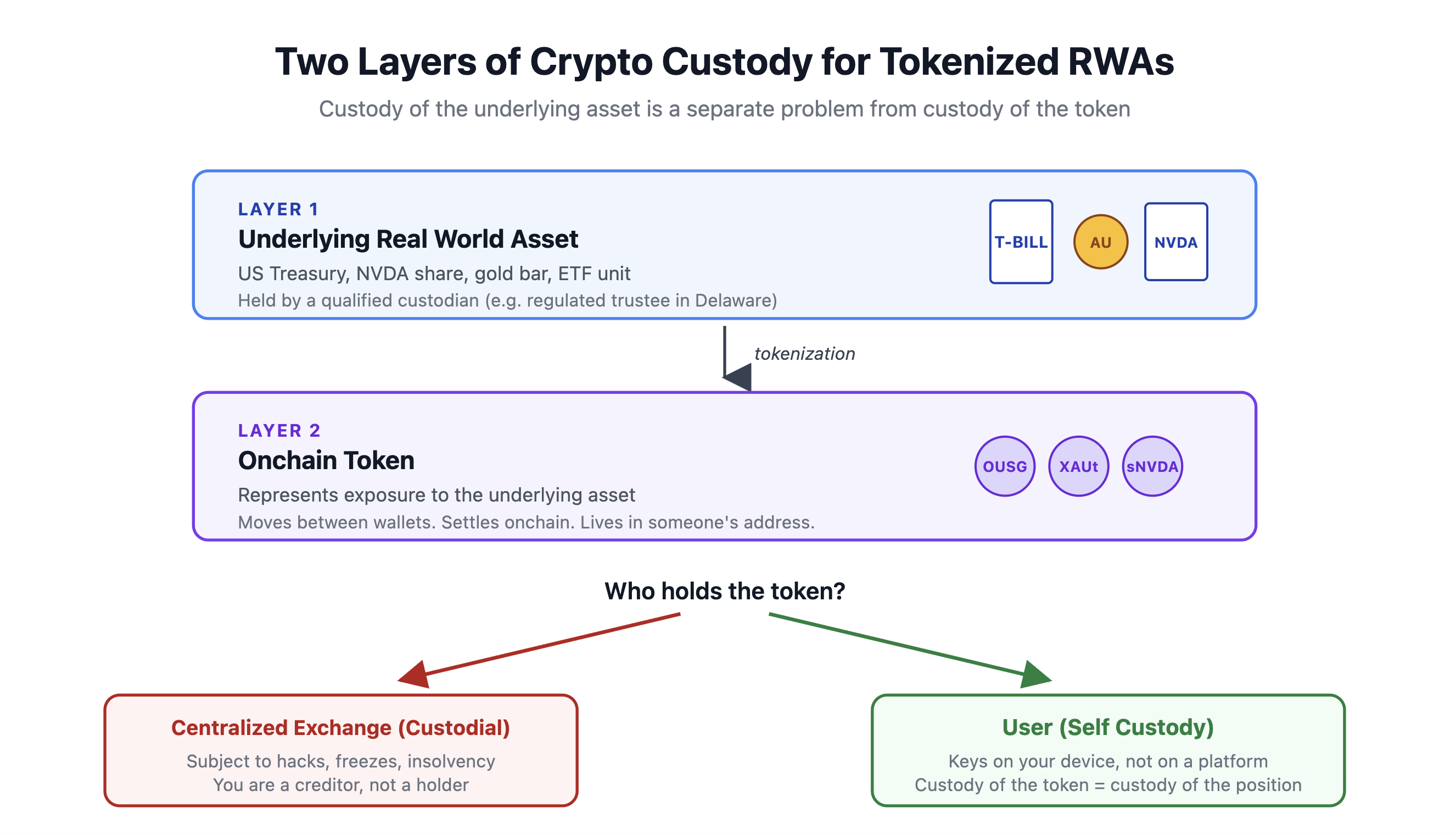
The custody problem doubles for these assets. There are two things to hold: the underlying real world asset, and the token that represents onchain exposure to it. Traditional brokerage custody handles the first. Crypto custody handles the second. A token sitting in an exchange wallet is still subject to every failure mode above, even if the underlying treasury is held by a regulated custodian in Delaware.
For traders, the custody question looks different in spot versus perps.
Spot. If you hold a tokenized equity, ETF, or commodity directly, custody of the token is custody of the position. The NVDA exposure, gold exposure, or Korean equity ETF exposure sits in a wallet, and whoever controls the wallet controls the exposure. An exchange that holds those tokens on your behalf is an exchange that can lose them.
Perps. When you trade perpetuals on crypto or on tokenized RWAs, you do not hold the underlying. You hold collateral (typically USDT or another stable asset) and an open position against it. Custody shifts to the margin. If the centralized exchange holds your collateral, you are still a creditor for the full value of that deposit, exactly the same failure mode covered earlier.
Across spot, CEX perps, and perp DEX trading, the question is the same: am I in custody of the assets that define my exposure, or is someone else holding them. If you are holding tokenized equities, tokenized gold, or tokenized ETFs onchain in spot, or running perps on any of them, the venue's custody model is the first variable in your risk stack.
Trading Without Giving Up Custody
The old model forced a choice. Trade fast on a centralized exchange and accept custody risk. Trade safely on a fully onchain DEX and accept latency. Newer architectures dissolve that tradeoff.
Grvt uses a hybrid architecture. Order matching runs offchain for CEX level speed. Settlement runs onchain through audited smart contracts. User collateral is governed by those contracts, not by Grvt as a company.
On Grvt, a deposit is not a transfer of custody. It is a signed authorization for specific audited contracts to settle trades on your behalf. The keys stay with you.
Before You Deposit Anywhere
Whether you are evaluating Grvt or any other venue, five questions will tell you everything:
- Who controls the private key to the wallet my funds land in
- Can the platform freeze my withdrawals unilaterally
- Are the settlement contracts audited, and by whom
- If this venue went offline tomorrow, could I recover my funds
- Is there a public, onchain way to verify solvency at any moment
If the answers point back to the platform rather than to verifiable, audited code, you are using a custodian.
The Bottom Line
Crypto custody is not a niche preference anymore. It is the default posture for anyone who watched a custodial venue collapse, and it is the only posture that makes sense for the tokenized asset economy now forming onchain. The tradeoff between safety and speed has been engineered away. You can trade perps, spot, and tokenized real world assets without your keys ever leaving your wallet.
That is what Grvt is built for.
Start trading on Grvt without giving up custody →