How to Trade Tokenized Gold and Other Commodities
Learn how to trade tokenized gold on-chain. Go long or short on commodities, no minimums, real-time prices & on-chain settlement on Grvt.
For centuries, gold has been the world's most trusted store of value. Yet actually trading it has always been friction-heavy, futures contracts with margin requirements, ETFs locked behind brokerage accounts, physical bars that require vaulting and insurance.
Tokenized commodities change that. Today, traders can get direct on-chain exposure to gold, silver, oil, and other real-world assets in the same wallet they use to trade crypto with no intermediary, no broker, and no custody headaches.
This guide walks through exactly how tokenized commodity trading works, what you need to know before you start, and how platforms like Grvt are making this accessible to a new generation of traders.
Why Gold? The Market Case Right Now
Gold is not having a moment. It's having a cycle and by most metrics, it's still in the middle of it.
After setting 53 all-time price highs during 2025 alone, gold entered 2026 trading above $5,000 per troy ounce. J.P. Morgan's Global Commodities Strategy team forecasts prices reaching $5,000/oz by year-end 2026, driven by continued central bank accumulation and sustained investor demand. At current levels, gold has nearly doubled the returns of the S&P 500 over the trailing 12 months, making it the best-performing major asset class over that period.
| Metric | Data |
|---|---|
| Gold price (April 2026) | ~$5,060/oz |
| 2025 full-year price gain | +55% |
| 2025 all-time highs set | 53 |
| Central bank purchases (2025) | 863 tonnes |
| J.P. Morgan 2026 target | $5,000/oz |
At the same time, other commodities are beginning to attract renewed attention. Silver is benefiting from both monetary demand and its role in industrial applications like solar, copper continues to track global growth and electrification trends, and platinum is seeing cyclical demand tied to automotive and hydrogen technologies. Together, these markets highlight a broader shift: commodities are no longer just macro hedges. They’re becoming active trading instruments, especially as tokenization brings them on-chain.
What Are Tokenized Commodities?
A tokenized commodity is a digital token issued on a blockchain that represents ownership of, or price exposure to, a real-world physical asset like gold, silver, or crude oil.
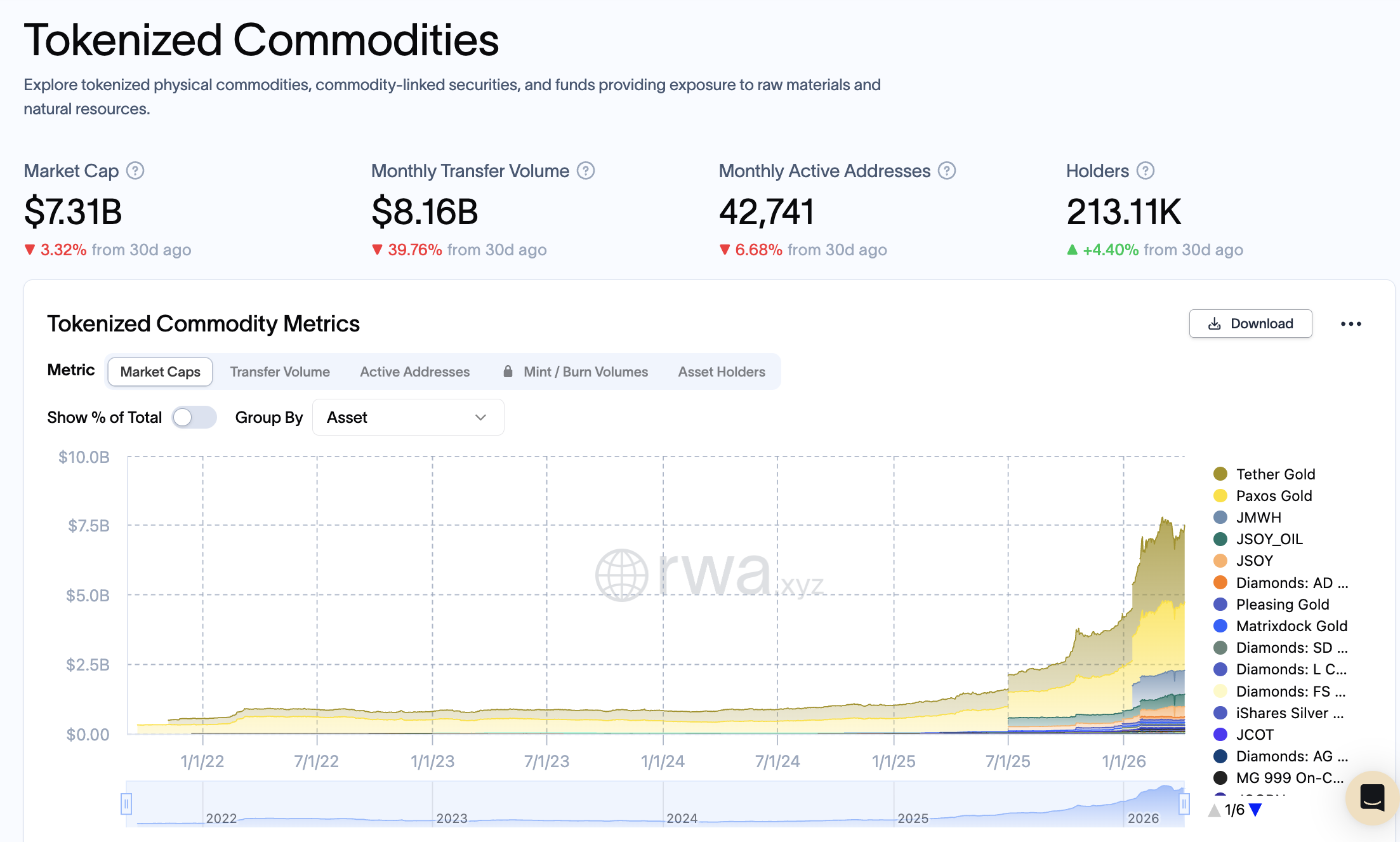
The market for these assets has grown significantly. According to rwa.xyz, tokenized commodities now represent a $7.31B market cap as of April 2026, up from under $500M just two years prior, with over 213,000 holders and $8.16B in monthly transfer volume. Gold tokens (Tether Gold and Paxos Gold) account for the large majority of that market cap, though silver, oil, and even diamond tokens are beginning to carve out a presence.
The token's value is pegged to the underlying commodity. Hold one token of tokenized gold, and its price tracks the spot price of gold. Sell it, and you receive the equivalent in stablecoins or another settlement currency.
There are two main structures:
| Type | How It Works | Example |
|---|---|---|
| Asset-backed | Each token is backed 1:1 by physical reserves held in custody | XAUT (Tether Gold), PAXG |
| Synthetic / price-tracked | Token tracks the price via an oracle or derivative mechanism | On-chain gold perps, RWA tokens |
Both give you price exposure to commodities. The key differences are custody, counterparty risk, and liquidity.
On Grvt, you can trade two of the most established tokenized gold perps directly:
- XAUT (Tether Gold) — each token represents one troy ounce of physical gold held in Swiss vaults by Tether. Trade XAU-USDT Perps on Grvt →
- PAXG (Pax Gold) — each token is backed 1:1 by a fine troy ounce of a London Good Delivery gold bar, held in Brink's vaults. Trade PAXG-USDT Perps on Grvt →
Both give you real-time gold price exposure with on-chain settlement, no brokerage account, no futures contract, no minimum position size.
Why Trade Commodities On-Chain?
Traditional commodity trading involves multiple intermediaries: commodity exchanges, brokers, clearing houses, and custodians. This adds cost, friction, and minimum position sizes that exclude most retail traders.
Tokenized commodities offer a different model:
- No minimum investment. Trade fractional positions. You don't need to buy a full gold futures contract (which represents 100 troy ounces, or roughly $300,000+ at current prices).
- 24/7 markets. Commodity futures markets close on weekends. On-chain markets don't.
- Self-custody option. With the right platform, you hold tokens in your own wallet.
- Composability. On-chain commodities can interact with DeFi protocols — use tokenized gold as collateral, for example.
- Lower barriers for international traders. No local brokerage account or jurisdiction restrictions required.
The trade-off: liquidity in tokenized commodity markets is still developing compared to major commodity exchanges. Slippage matters, especially in larger positions.
How to Trade Tokenized Gold: Step by Step
Before getting into the mechanics, it's worth understanding the two ways to get on-chain gold or other commodities exposure because the experience and risk profile differ.
Spot (buying the token directly) You purchase and hold XAUT or PAXG directly. Your wallet holds the token, its value tracks the gold spot price, and you can transfer or sell it at any time. Some issuers (like Paxos) allow redemption for physical gold under certain conditions. This is the closest on-chain equivalent to owning gold outright.
Perpetuals (trading gold price exposure) You open a long or short position on a gold-pegged perpetual contract like XAU-USDT or PAXG-USDT on Grvt. There's no expiry date, positions are marked to the gold spot price via an oracle, and funding rates periodically exchange between longs and shorts to keep the contract anchored to spot. You don't hold the underlying token, and you have no claim on physical gold. What you get is leveraged, capital-efficient price exposure tradeable 24/7 with on-chain settlement.
On Grvt, you're trading perpetuals. The steps below reflect that flow.
1. Choose the Right Platform
Not all platforms offer tokenized commodities. You need one that:
- Lists tokenized gold (or other commodity tokens)
- Has sufficient liquidity for your position size
- Offers transparent pricing tied to real-world spot prices
- Has a clear settlement mechanism
Grvt lists tokenized gold perps directly. As an institutional-grade, privacy-first DEX built on the ZKSync stack, it runs a central limit order book (CLOB), giving traders the speed, liquidity depth, and intuitive trading experience of a top-tier CEX, while keeping settlement on-chain and assets in your own custody.
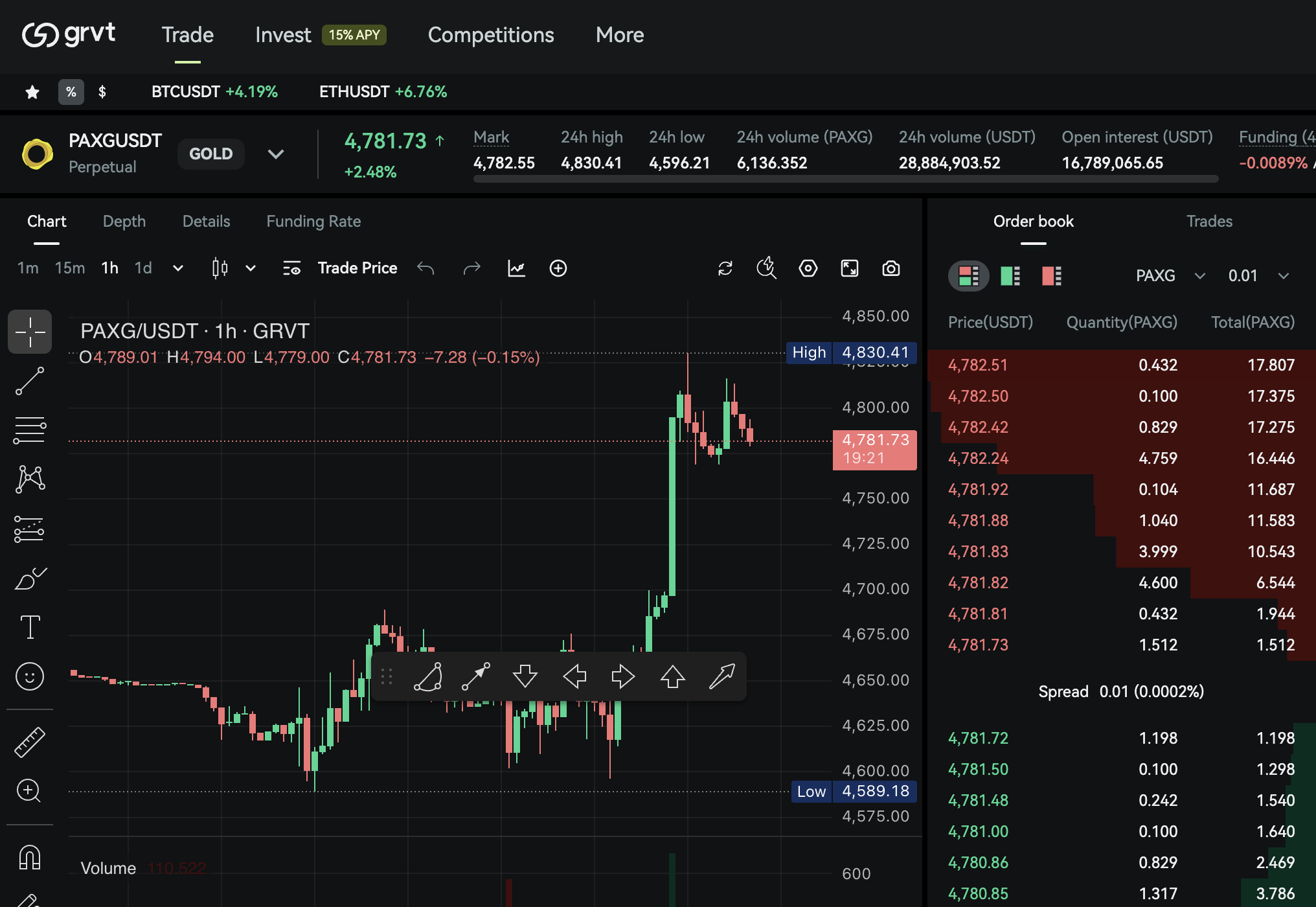
You can view available RWA assets at grvt.io
2. Set Up and Fund Your Wallet
To trade on a non-custodial platform:
- Create a compatible wallet. MetaMask or any EVM-compatible wallet works with most zkSync-based platforms.
- Fund Your Account Deposit USDT or USDC directly into your Grvt account from any supported network, Arbitrum One, Base, BNB Smart Chain, Kaia, Solana, or Tron. No manual bridging required; Grvt handles the cross-chain routing so you can go from deposit to trading in a few clicks.
- Transfer to your trading account. Once deposited, transfer funds from your funding account to your trading account to start placing orders. Your trading account balance earns up to 11% APY while idle so your collateral is working even when you're not in a position.
3. Understand the Pricing Mechanism
Before you trade, understand how the platform prices the commodity token.
Most platforms use a Chainlink oracle or similar price feed to anchor the token's value to the real-world spot price. Check:
- Oracle source. Is it a reputable, manipulation-resistant feed?
- Update frequency. How often does the price refresh?
- Spread. What's the bid/ask spread? Tight spreads mean lower trading costs.
4. Place Your Trade
Once funded, placing a trade is similar to any spot or derivatives trade:
- Navigate to the commodity market (e.g., tokenized gold)
- Choose your position size
- Select order type: market (instant fill at current price) or limit (fill at your specified price)
- Review the estimated fill price, fees, and slippage
- Confirm the transaction
For larger positions, always use a limit order. Slippage on market orders can be significant in less liquid markets.
5. Manage Your Position
Active position management matters in commodity trading. Gold is less volatile than crypto, but it reacts to:
- USD strength/weakness (inverse relationship)
- Inflation data and central bank decisions
- Geopolitical risk
- Real interest rates (gold tends to rise when real rates fall)
Set price alerts or use stop-loss orders to manage downside. On Grvt, you can set stop-loss and take-profit orders directly from the trading interface.
Other Tokenized Commodities to Know
Gold gets the most attention, but the tokenized commodity universe is expanding. Here's where things stand:
| Commodity | Tokenized Version | Use Case |
|---|---|---|
| Gold | XAUT, PAXG, on-chain gold tokens | Inflation hedge, store of value |
| Silver | XAG, synthetic silver tokens | Industrial + monetary metal |
| Oil | Synthetic crude (limited liquidity) | Energy exposure, macro hedge |
| Copper | Early-stage tokenization efforts | Industrial demand play |
| Carbon credits | Toucan Protocol, KlimaDAO | Environmental hedging / ESG |
Of these, gold has the deepest tokenized liquidity by a significant margin. Silver is available but thinner. Oil tokenization is still early, with most exposure coming through synthetic derivatives rather than backed tokens.
For traders looking for commodity diversification beyond gold, tokenized ETFs on platforms like Grvt provide another route, for example, holding exposure to equity indices with commodity correlations (EWY, EWJ) while remaining in the on-chain ecosystem.
Key Risks to Understand
Tokenized commodities carry distinct risks that don't exist in traditional commodity markets.
Smart Contract Risk
The token exists on a blockchain, governed by smart contracts. Bugs or vulnerabilities in those contracts can result in loss of funds. Audit reports matter, always check whether the underlying token has been independently audited.
Oracle Manipulation
Price feeds can be manipulated in low-liquidity scenarios, leading to incorrect pricing. Using platforms that source prices from multiple reputable oracles reduces this risk.
Custody and Reserve Risk (for backed tokens)
If you hold an asset-backed gold token, your real exposure is to both the price of gold and the trustworthiness of whoever holds the physical gold. Counterparty risk doesn't disappear. It just changes form.
Liquidity Risk
Tokenized commodity markets are less liquid than traditional futures markets. Large positions may face meaningful slippage, particularly in volatile conditions.
Regulatory Uncertainty
The regulatory treatment of tokenized real-world assets is still evolving across most jurisdictions. Platform access may change as rules develop.
Tokenized Gold vs. Traditional Gold Exposure: A Quick Comparison
| Tokenized Gold | Gold ETF | Gold Futures | |
|---|---|---|---|
| Custody | Self-custodied or platform | ETF provider | No physical custody |
| Minimum trade | Fractional | ~1 share | ~100 oz contract |
| 24/7 trading | ✅ | ❌ | ❌ |
| Settlement | On-chain, near-instant | T+2 | Cash or delivery |
| Counterparty risk | Smart contract / issuer | Fund manager | Exchange + broker |
| Accessibility | Global, non-custodial | Brokerage account required | Futures account required |
| Fees | Trading fees + gas | Management fee + spread | Commission + roll costs |
There's no universally "better" option. The right structure depends on your position size, time horizon, and tolerance for smart contract risk.
Why Grvt for Tokenized Commodity Trading
Grvt is designed for traders who don't want to choose between the security of self-custody and the performance of a centralized exchange. As a hybrid DEX on zkSync:
- Order book matching happens off-chain for speed and capital efficiency
- Settlement is on-chain via ZKSync's zero-knowledge proof system
- Your assets stay in your wallet. Grvt never takes custody.
Grvt lists tokenized gold alongside other real-world assets, such as stocks and ETFs, letting traders manage commodity and traditional asset exposure within the same trading environment they use for crypto perpetuals.
For traders building a multi-asset portfolio, combining crypto, tokenized equities, and commodities, this matters. Portfolio-level risk management is simpler when everything lives in one ecosystem.
Getting Started
Tokenized commodity trading is still early, which means both the opportunity and the learning curve are real. The traders building familiarity with RWA infrastructure now are positioning themselves well for when liquidity deepens and the product set matures.
The mechanics aren't complicated. The key is choosing a platform with real on-chain settlement, transparent pricing, and enough liquidity for your trade size.
Explore tokenized gold and other RWA assets on Grvt →
Read More
Trading involves risk. This article is for informational purposes only and does not constitute financial advice.