How to Trade RWA Perps: A Complete Guide for 2026
Learning how to trade RWA perps is easier than you think. This guide breaks down everything from what real-world asset perpetuals are, to step-by-step trading, platform comparisons, and risk management. So you can start trading with confidence in 2026.
Real-world asset perpetual contracts (RWA perps) are the fastest-growing product category in crypto derivatives. They let you trade synthetic exposure to commodities (e.g. gold, crude oil, natural gas), forex pairs, equities, and even Treasuries, all using perpetual futures, all from a crypto wallet. No brokerage account, no market hours, no custody of the underlying asset.
By early 2026, perpetual DEX volumes alone surpassed $1.2 trillion per month, with RWA perps capturing an increasingly large share. Coinbase Ventures, Delphi Digital, and other major players have flagged RWA perps as a defining theme for 2026. If you trade crypto derivatives and haven't looked at RWA perps yet, you're leaving optionality on the table.
If you want to know how to trade RWA perps, this guide walks you through everything you need to know, from the basics to a step-by-step trading workflow, key risks, and a platform comparison.
What Are RWA Perps?
RWA perps combine two concepts:
- Real-world assets (RWAs) : traditional financial instruments like gold, crude oil, S&P 500 stocks like Tesla (TSLA), forex pairs (EUR/USD, GBP/JPY), and U.S. Treasuries, represented as tokenized or synthetic assets on-chain.
- Perpetual contracts: derivative contracts with no expiration date that track the price of an underlying asset. Unlike traditional futures, you never need to roll positions.
Put them together: RWA perps are perpetual futures contracts that give you leveraged, synthetic exposure to real-world assets. It is settled entirely in crypto (typically USDC or USDT), tradeable 24/7, and accessible from any crypto wallet.
How They Differ From Traditional Tokenized RWAs
Tokenized RWAs (like tokenized Treasury bonds or on-chain gold) require actual custody of the underlying asset by an issuer. RWA perps skip this entirely. They use price oracles to track the real-world price and settle profits and losses in stablecoins. This means faster listing of new assets, no custody overhead, and the ability to go both long and short with leverage.
Funding Rates Keep Prices Anchored
Like any perpetual contract, RWA perps use a funding rate mechanism to keep the contract price aligned with the oracle price of the underlying asset. When the perp trades above the oracle price, longs pay shorts. When it trades below, shorts pay longs. This creates a continuous arbitrage incentive that keeps prices tight.
Why Trade RWA Perps?
RWA perps aren't just a novelty. They solve real problems for crypto-native traders who want broader market exposure.
1. Access Traditional Markets From a Crypto Wallet
Want to short EUR/USD or go long crude oil? Traditionally, that requires a forex broker or commodities account with KYC, minimum deposits, and platform lock-in. RWA perps let you access these markets directly from your existing crypto wallet and margin. One account, one collateral pool, every market.
2. Trade 24/7 — Even When Traditional Markets Are Closed
U.S. equity markets close at 4 PM ET. Forex has weekend gaps. Commodities have session breaks. RWA perps trade around the clock, 365 days a year. If news breaks on a Sunday night, you can act on it immediately instead of waiting for Monday's open.
3. Go Long or Short With Leverage
Most tokenized RWA products only let you go long. You can only buy and hold. RWA perps give you the full derivatives toolkit: long, short, leverage (typically 5x–50x depending on the asset), stop-losses, take-profits, and limit orders. You can hedge, speculate, or run delta-neutral strategies across both crypto and traditional asset classes.
4. Capital Efficiency
Because RWA perps are synthetic, no one needs to custody barrels of oil or stock certificates. They're extremely capital efficient. You can deploy the same USDC collateral across crypto perps, commodity perps, and forex perps within a single platform. On exchanges with portfolio margin, your positions offset each other, reducing total margin requirements.
5. Portfolio Diversification
Crypto markets are highly correlated. When BTC drops, most altcoins follow. RWA perps let you diversify into uncorrelated assets, gold, oil, bonds, forex, without leaving the crypto ecosystem. This is particularly powerful for hedging: go long gold perps as a hedge against a risk-off move in crypto, for example.
How to Trade RWA Perps: Step-by-Step
Here is a practical step-by-step walkthrough on how to trade RWA perps for beginners and experienced crypto traders alike.
Step 1: Choose a Platform
Select a platform that supports RWA perpetual contracts. Key factors to evaluate:
- Asset coverage. Does it list the RWA markets you want (forex, commodities, equities, indices)?
- Liquidity and spreads. Thin order books mean higher slippage, especially on less popular RWA pairs.
- Leverage options. Typical range is 5x–50x for RWA perps, lower than crypto perps due to underlying asset volatility profiles.
- Custody model. CEX, DEX, or hybrid? Self-custody matters if you're managing significant capital.
- Fee structure. Maker/taker fees, funding rate spreads, and withdrawal fees all eat into returns.
We compare the major platforms in detail below.
Step 2: Fund Your Account
Most RWA perp platforms accept USDC or USDT as collateral. The typical flow:
- Connect your wallet (MetaMask, Rabby, or WalletConnect-compatible wallet) or create an account on a centralized platform.
- Deposit stablecoins. On DEX platforms, this usually means bridging USDC to the relevant L2 (Arbitrum, zkSync, etc.).
- Your deposited stablecoins become your available margin for opening positions.
Step 3: Select Your Market
Navigate to the trading interface and select an RWA perp market. Common categories include:
- Commodities. Gold (XAU/USD), Silver (XAG/USD), Crude Oil (WTI), Natural Gas
- Forex. EUR/USD, GBP/USD, USD/JPY, AUD/USD
- Equities. AAPL, TSLA, NVDA, SPY (S&P 500 index)
- Fixed Income. U.S. Treasury yields, bond indices
Step 4: Set Your Position Parameters
Before executing a trade, configure:
- Direction. Long (betting price goes up) or Short (betting price goes down).
- Position size. The notional value of your trade. Start small while learning a new asset class.
- Leverage. Higher leverage amplifies both gains and losses. For RWA perps, 5x–10x is a sensible starting range.
- Order type. Market order (execute immediately at best available price), Limit order (execute at your specified price or better), or Stop order (trigger at a specified price level).
Step 5: Manage Risk
This is where most traders either succeed or blow up. Before clicking "confirm":
- Set a stop-loss. Decide your maximum acceptable loss before entering the trade. Place a stop-loss order at that level. Non-negotiable.
- Set a take-profit. Know your target. Greed without a plan is how winners become losers.
- Size appropriately. A common rule: risk no more than 1–2% of your total account on a single trade.
- Monitor funding rates. If you're paying funding, your position has a carrying cost. A 0.05% funding rate paid every 8 hours compounds to ~6.7% per month. Factor this in. (Learn more about Grvt Funding Rate Mechanism.)
Step 6: Monitor and Close
Once your position is open:
- Watch your unrealized P&L and margin ratio.
- Adjust stop-loss and take-profit levels as the trade develops.
- Be aware of upcoming events that affect your underlying, FOMC meetings for forex/bonds, OPEC decisions for oil, earnings for equities.
- Close manually or let your TP/SL orders execute automatically.
Key Risks of Trading RWA Perps
RWA perps are powerful instruments, but they come with risks that are distinct from standard crypto perps.
1. Oracle Risk
RWA perps rely on price oracles to determine the value of the underlying asset. If an oracle is delayed, manipulated, or provides stale data, especially during volatile traditional market sessions, you can get liquidated on a price that doesn't reflect reality. Different platforms handle this differently: some use a median of multiple oracle feeds, others use order book-derived mark prices as a safeguard.
2. Off-Market Hours Gaps
While RWA perps trade 24/7, the underlying assets don't. U.S. stocks close every night. Forex is closed on weekends. When the underlying market reopens, accumulated price pressure is released instantaneously, creating a "gap" that can blow through stop-losses or trigger mass liquidations. Some platforms use synthetic pricing (exponential moving averages) during off-hours, but this introduces its own manipulation surface.
3. Liquidity Risk
RWA perps are newer and generally less liquid than major crypto perps like BTC or ETH. Wider spreads, thinner order books, and higher slippage are common, especially on smaller platforms or less popular asset pairs. Always check order book depth before sizing into a position.
4. Regulatory Uncertainty
Synthetic exposure to stocks and commodities sits in a legal gray area in many jurisdictions. Platforms offering equity perps may face regulatory action, which could result in sudden market closures, forced position liquidations, or restricted access for users in certain countries. Stay informed about your jurisdiction's stance.
5. Smart Contract Risk
On decentralized platforms, your funds interact with smart contracts. Bugs, exploits, or governance attacks can result in loss of funds. Use platforms that have undergone rigorous audits, have bug bounty programs, and have been battle-tested with meaningful TVL over time.
6. Funding Rate Drag
Holding a position long-term means paying or receiving funding rates every 8 hours. In trending markets, funding can consistently work against you, longs pay in bullish markets, shorts pay in bearish markets. If you're holding a position for days or weeks, model your funding costs before entering.
RWA Perps Platforms Compared: Where to Trade in 2026
Here's how the major platforms stack up for RWA perp trading.
Hyperliquid
Hyperliquid is the dominant perpetual DEX by volume ($739B+ monthly by early 2026). Its HIP-3 upgrade introduced permissionless perp listings, enabling anyone to deploy RWA perp markets.
- Strengths: deep liquidity on major pairs, fast execution, established ecosystem.
- Weaknesses: newer RWA pairs may have thin liquidity, fully on-chain architecture means all trades are public.
Ostium
Ostium is purpose-built for RWA perps, offering commodities, forex, and equity index perpetuals on Arbitrum. It uses a liquidity pool model with oracle-based pricing.
- Strengths: focused RWA coverage, clean UX, gasless smart wallet onboarding.
- Weaknesses: oracle-dependent pricing model, newer platform with less battle-testing.
dYdX
dYdX runs its own appchain with a traditional order book model. It has expanded into RWA perps with select forex and commodity pairs.
- Strengths: mature platform, strong decentralization, familiar order book interface.
- Weaknesses: smaller RWA asset selection compared to specialized platforms.
Centralized Exchanges (Bitget, Bybit, OKX)
Major CEXs are launching RWA index perpetuals and individual asset perps. Bitget, for example, launched the first RWA index perpetual with 10x leverage.
- Strengths: deep liquidity, institutional infrastructure, fiat on-ramps.
- Weaknesses: custodial (not your keys), potential for regulatory-driven market restrictions.
Grvt
Grvt takes a hybrid approach, combining the self-custody guarantees of a DEX with the speed and UX of a centralized exchange. Built on ZKSync with ZK-powered settlement, Grvt 2026 roadmap includes expanding perpetual contracts for global stocks, forex, and commodities as part of a unified trading layer.
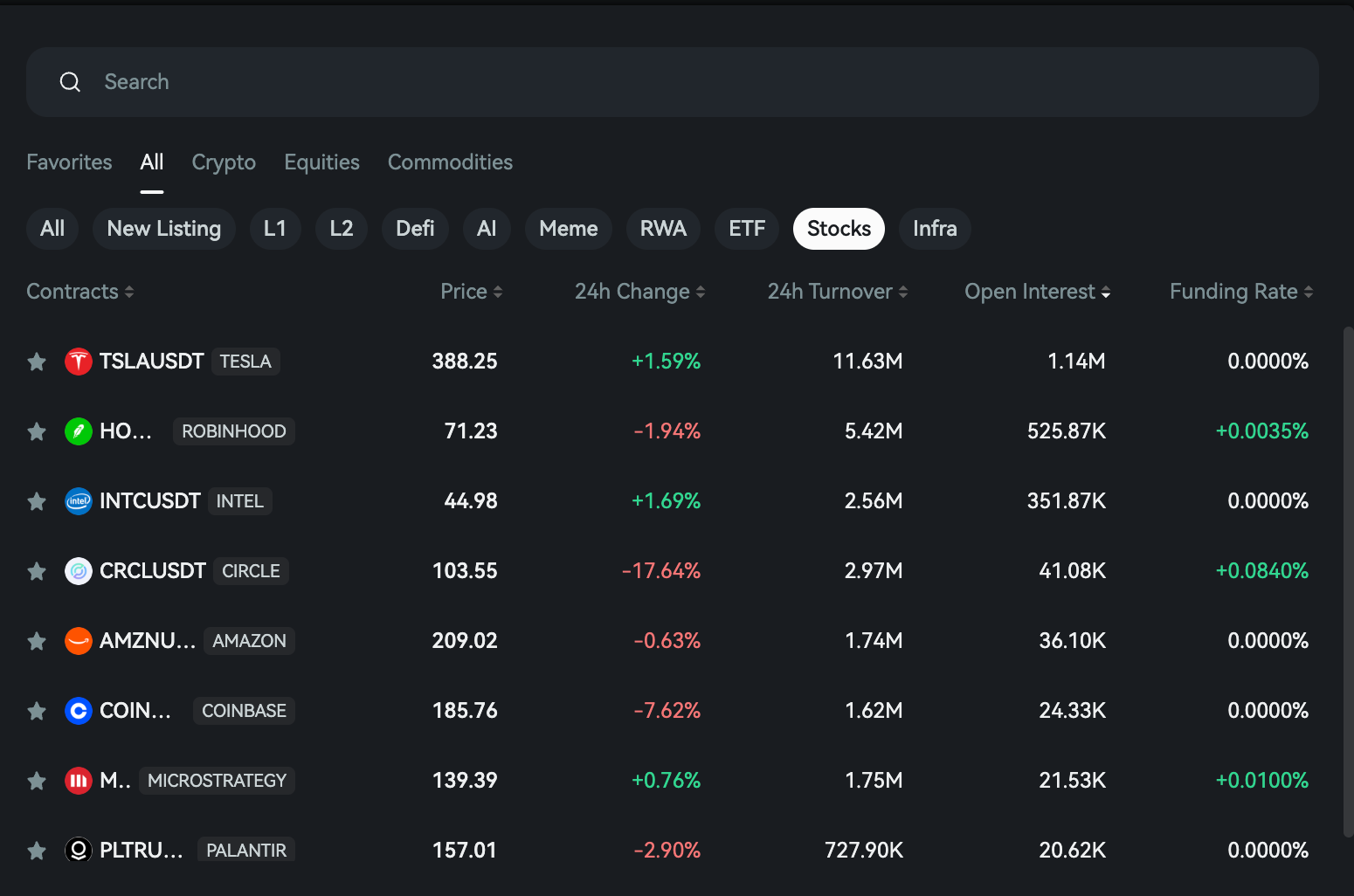
Currently, Grvt already supports a wide range of live RWA perp markets, including commodities like gold (XAU), Silver (XAG), crude oil (WTI), natural gas, high-demand equities like Amazon, Tesla, and Robinhood, and recently added index ETF perps such as EWJ (iShares MSCI Japan) and EWY (iShares MSCI South Korea).
Most recently, Grvt expanded its RWA equity coverage further with new tokenized perps spanning tech, consumer, and semiconductor exposure: Oracle (ORCL), Cisco (CSCO), Marvell (MRVL), and Lumentum (LITE) for traders positioning around the AI infrastructure and networking cycle, alongside consumer names like Uber (UBER), Disney (DIS), and Home Depot (HD). For traders looking for leveraged sector exposure, Grvt also added Direxion Daily Semiconductor Bull 3X (SOXL), giving access to amplified semiconductor moves in a single perp.
What sets it apart is a single programmable balance that simultaneously serves as margin, earns yield, and maintains spot exposure. This means your collateral works harder across every market. For traders who want institutional-grade infrastructure without giving up custody of their funds, Grvt is already live and expanding.
Start trading RWA perps on Grvt →
Getting Started: Your First RWA Perp Trade
If you've traded crypto perps before, RWA perps will feel familiar. If you haven't, here's how to trade RWA perps on Grvt:
- Create your Grvt account. Sign up at grvt.io — the onboarding is wallet-based, so no lengthy KYC process. Connect your wallet and you're in.
- Start with a familiar asset. Gold (XAU/USD) or EUR/USD are good first RWA perps because they're liquid, have tight spreads, and you probably already follow their price action.
- Use low leverage. 3x–5x max while you learn how the asset behaves on the platform.
- Trade during overlapping market hours. When both the underlying traditional market and the crypto market are active, you get the best liquidity and tightest oracle pricing.
- Watch the funding rate. Before entering, check the current funding rate and its recent history. If funding is heavily negative or positive, that tells you about market positioning and your carrying cost.
- Keep position sizes small. Until you understand the liquidity profile and slippage characteristics of each RWA pair, trade conservatively.
RWA perps represent a genuine expansion of what's possible in crypto trading — synthetic, leveraged access to the world's largest asset classes, all from a single wallet. The infrastructure is still maturing, but for traders who understand derivatives mechanics and manage risk deliberately, this is a category worth learning now.
Start trading RWA perps on Grvt →