How to Trade Tokenized ETFs: The Utimate Guide 2026
This guide covers how to trade tokenized ETFs on-chain. What they are, spot vs. perpetual, and how funds like EWY and EWJ are already trading 24/7 on Grvt.
ETFs, Crypto, and What Comes Next
ETFs changed investing. One ticker, a basket of assets, minimal fees. The model has been proved to be so powerful and it now holds over $15 trillion globally. When the SEC approved spot Bitcoin ETFs in January 2024, that wrapper extended to crypto: over $57 billion in inflows followed within the first year, and $880 billion in trading volume through 2025. The question in TradFi shifted from whether to get crypto exposure to how.
Tokenized ETFs are the next move, but in reverse. Instead of bringing crypto into TradFi, they bring TradFi assets on-chain. So why tokenization?
The Problem With Traditional ETFs
The ETF model is near-perfect, except for one thing: it still closes at 4pm on major exchanges like NYSE/Nasdaq.
A Bank of Japan rate decision lands at midnight. Samsung announces an earnings miss at 6am Tokyo time. A US-Japan trade deal breaks over the weekend. South Korean chip export controls hit the newswires at 2am EST. Traditional ETF holders are locked out, waiting for the market to open, watching the price gap against them.
For anyone operating in global markets, trading hours are not an inconvenience. They are a structural disadvantage. The world doesn't pause for the NYSE.
Tokenization fixes this. Understanding how to trade tokenized ETFs starts here. When an ETF is represented as an on-chain token, it inherits the properties of the blockchain it lives on, and the constraints of the traditional market fall away: 24/7 trading, global access.
Your position lives in your wallet, not on a broker's balance sheet. And on-chain finality replaces the T+2 settlement window.
The opportunity is significant. For the first time, anyone with a wallet can access global equity markets at any hour. And crypto-native traders get a direct line to real-world assets.
This guide covers how tokenized ETFs work, how to trade them on-chain, what to look for in a platform, and where early listings like EWY and EWJ are already showing what's possible.
What Is a Tokenized ETF?
A tokenized ETF is a blockchain-based token that tracks the price of a traditional exchange-traded fund. It mirrors the same underlying assets and market price, but instead of sitting in a brokerage account, it lives on-chain in a self-custody wallet.
Think of it as the ETF you already know but available around the clock. So automated strategies, AI agents, and algorithmic systems can act on market moves the moment they happen, not when an exchange decides to open.
Tokenized ETFs don't replace the underlying fund. They are on-chain representations that track its price. This means they give you exposure to the same market movements without requiring you to open a brokerage account, deal with FX conversion, or wait for a market to open.
Tokenized ETF vs. Traditional ETF: The Full Comparison
Before trading, it is worth understanding exactly where tokenized ETFs differ from their traditional counterparts and being honest about the tradeoffs.
| Feature | Traditional ETF | Tokenized ETF on Grvt |
|---|---|---|
| Trading hours | Market hours only (e.g. NYSE: 9:30am–4pm ET) | 24/7/365 |
| Custody | Held by your broker | Your wallet, your keys |
| Settlement | T+2 (two business days) | Near-instant, on-chain |
| Minimum trade size | 1 share or more | Fractional |
| Geographic access | Brokerage account + local restrictions | Wallet only |
| Trade privacy | Broker sees all activity | ZK-proof settlement |
Where tokenized ETFs win:
- 24/7 access. No market hours. No gaps. Trade when news breaks, not when exchanges allow.
- Self-custody. Your position lives in your wallet, not on a broker's balance sheet. No counterparty risk from the custodian.
- Global accessibility. No need for a global or local brokerage account, or currency conversion. Only a wallet is required to get started.
- Fractional trading. No minimum share size. Trade any amount.
What to keep in mind:
- No dividend distribution. Tokenized ETFs on Grvt currently track price only. They do not automatically pass through the dividends paid by the underlying fund.
- Spreads during off-hours. Liquidity is deepest during traditional market hours. Weekend or late-night trading may carry wider spreads than daytime sessions.
- Some crypto trading platforms also require KYC. Permissionless perp DEXs like Grvt typically have no such requirements.
The Tokenized ETF Landscape Today
Before diving into how to trade tokenized ETFs on-chain, it's worth understanding the two formats available, spot and perpetual, as they suit very different types of traders.
The market for tokenized ETFs and equities is young but moving fast. As of 2026, tokenized public equities represent roughly $683 million in on-chain value and over $1.7 billion in monthly transfer volume held across more than 129,000 wallets. The infrastructure buildout is accelerating: platforms like Robinhood, Coinbase, Kraken, Ondo, and BingX have all entered the space, and institutional names like BlackRock, Franklin Templeton, and JPMorgan have launched tokenized fund products of their own.
Each platform takes a different approach to what it list. Some focus on individual US equities, others on indices like the S&P 500 and Nasdaq 100, commodities like gold, or country-level ETFs like EWY and EWJ, both listed on Grvt. But before choosing where or what to trade, there's one structural distinction worth understanding: spot vs. perpetual.
Spot Tokenized ETFs
A spot tokenized ETF is a direct on-chain representation of the underlying fund, typically backed 1:1 by the actual asset held in custody. You buy it, you hold exposure to the price. There is no expiry, no funding rate, and no leverage involved by default. It behaves like owning the ETF itself, just on-chain, in your wallet, tradeable around the clock. Spot tokenized ETFs are best suited for investors who want straightforward, custody-controlled exposure to an asset without the complexity of derivatives.
Perpetual Tokenized ETFs
A perpetual (or "perp") is a derivative contract that tracks the price of the underlying asset without ever expiring. Unlike spot, you don't hold the asset but you hold a position. Perps allow leverage, enable short selling, and are settled in stablecoins like USDC. They carry a funding rate: a periodic payment between long and short traders to keep the contract price anchored to the underlying. Platforms like Binance, Kraken, and Grvt have begun listing tokenized ETF perps, giving traders leveraged, 24/7 exposure to these assets with the same mechanics as crypto perpetuals.
| Spot Tokenized ETF | Perpetual Tokenized ETF | |
|---|---|---|
| Ownership | On-chain token, 1:1 backed | Derivative position, no direct ownership |
| Leverage | No (by default) | Yes |
| Short selling | Limited | Yes |
| Funding rate | No | Yes |
| Best for | Long-term holders, passive exposure | Active traders, hedging, directional bets |
Asia Tokenized ETFs in the Spotlight: EWY & EWJ
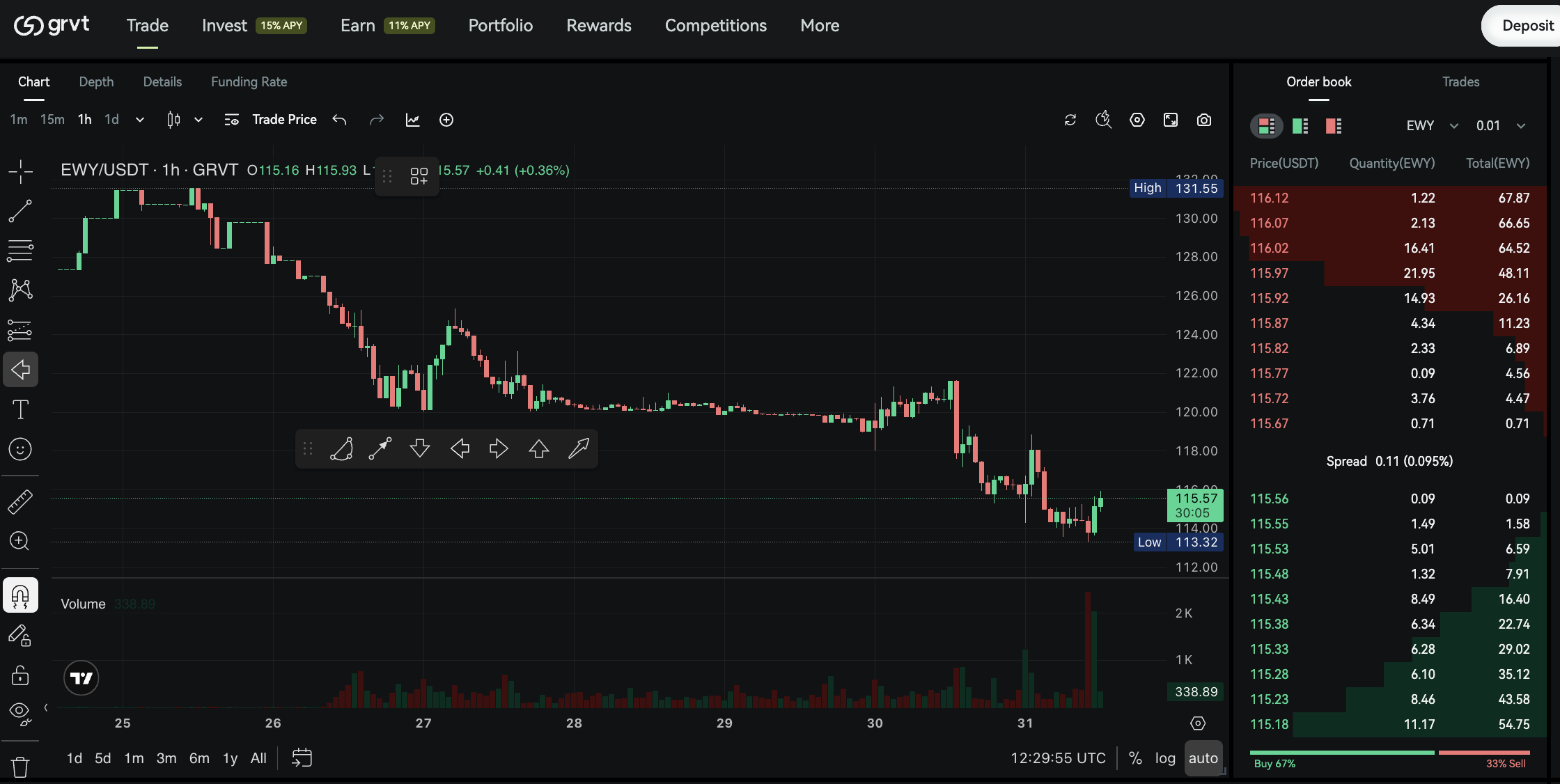
Grvt's first tokenized ETF listings are two of the most widely traded Asia-focused funds in the world: EWY and EWJ, both issued by BlackRock's iShares. They represent two distinct but equally compelling investment stories: South Korean semiconductors and Japanese equities. Together they make Grvt one of the most interesting places to express Asia macro views on-chain.
EWY — iShares MSCI South Korea ETF
Issued by BlackRock, EWY is the most liquid ETF for Korean equity exposure globally. It is a concentrated, tech-heavy fund: Samsung Electronics (~22.9%) and SK Hynix (~20.75%) alone make up over 40% of the portfolio, with the top 10 holdings representing 58% of the fund. Trading EWY is effectively a direct bet on the Korean semiconductor supply chain powering the global AI buildout.
The numbers back this up: EWY has seen over $6 billion in three-month net inflows, one of the strongest momentum stories in Asian equities heading into 2026. Korean chip news, however, breaks around the clock. US export controls, Nvidia earnings, TSMC guidance, these move EWY outside NYSE hours. Tokenized EWY on Grvt means you don't have to wait for New York to open.
EWJ — iShares MSCI Japan ETF
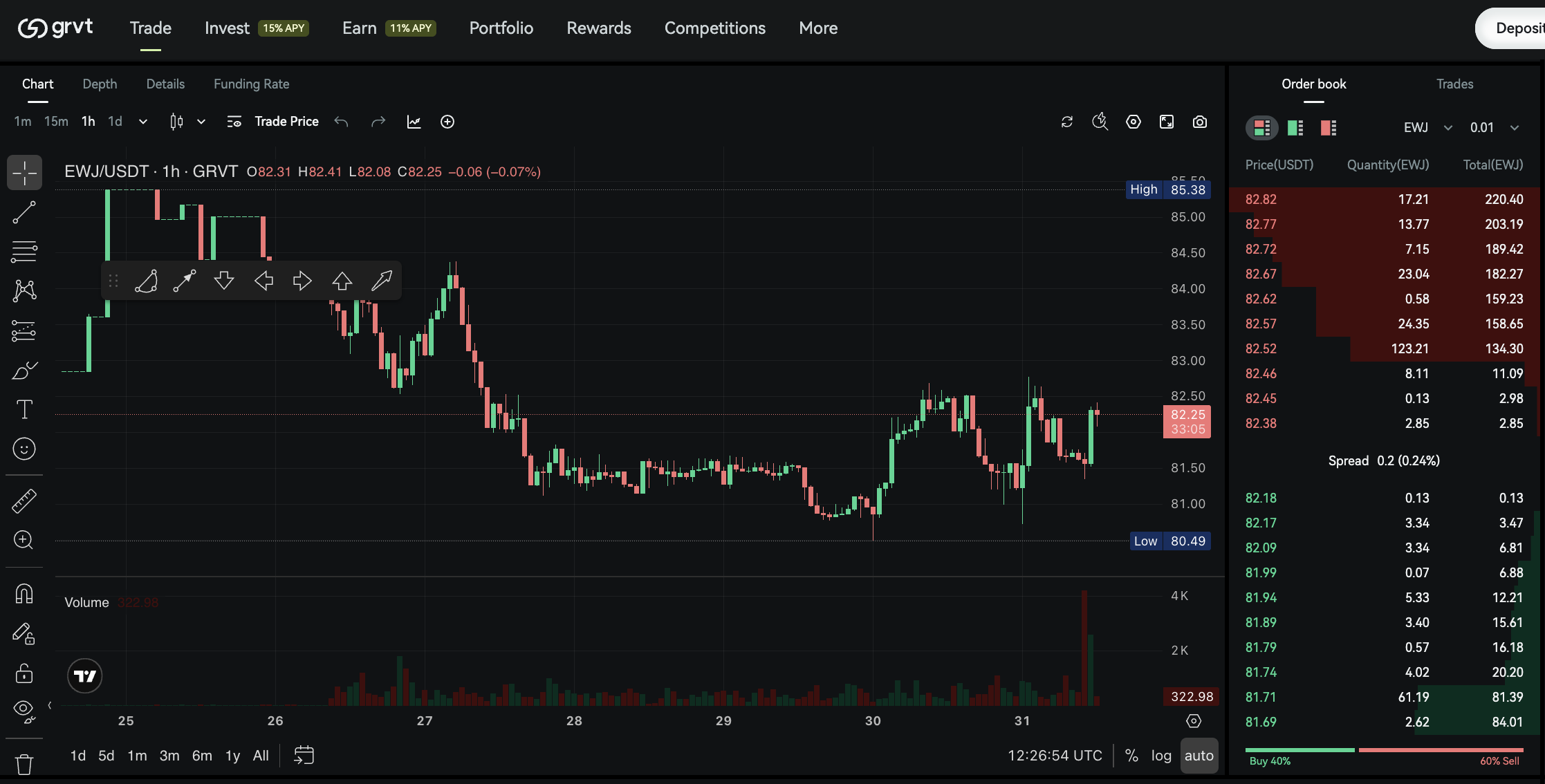
Launched in 1996, EWJ is the oldest and most popular ETF for Japanese equity exposure. Unlike EWY's chip concentration, it holds hundreds of stocks across industrials (~25%), consumer discretionary, financials, and technology, names like Toyota, Sony, Mitsubishi UFJ, and Tokyo Electron. It trades like a macro instrument on Japan's economy, the yen, and foreign investor appetite.
Japan's equity market has re-entered the global spotlight: EWJ hit record highs after the 2025 US-Japan trade deal and has pulled in over $3 billion in three-month net inflows. It also carries a trailing dividend yield of ~3.95%, above the category average, adding an income angle beyond price trading. Bank of Japan rate decisions, yen moves, and earnings catalysts regularly break outside NYSE hours, making tokenized EWJ on Grvt the only on-chain way to act on them in real time.
How to Trade Tokenized ETFs on Grvt: Step by Step
Step 1: Create and Verify Your Grvt Account
Go to grvt.io and sign up. Onboarding requires KYC verification through ComplyCube — document verification and a biometric check. This takes a few minutes and is a one-time process. KYC is the compliance layer that makes it possible for Grvt to list regulated assets like tokenized ETFs in the first place.
Step 2: Fund Your Account
Deposit USDT or other supported stablecoins directly to your Grvt wallet. If you're coming from another chain, BNB, SOL, Kaia or others, Grvt also enables smooth cross-chain transfers without manually wrapping or swapping assets first.
Step 3: Find EWY or EWJ in the ETF Tab
Navigate to the RWA section of the platform. EWY and EWJ are listed under “ETF” tab. The order book interface will be immediately familiar to anyone with TradFi trading experience. Grvt uses a Central Limit Order Book (CLOB) model, the same structure used by traditional exchanges, rather than an AMM.
Step 4: Place Your Trade
Choose between a market order (execute immediately at current price) or a limit order (set your target price and wait for a fill). Both are available. Because EWJ and EWY trade 24/7, you can set limit orders to trigger on overnight moves without needing to be present.
Step 5: Manage Your Position
Your position is visible in the Grvt portfolio dashboard. Take-profit and stop-loss (TPSL) functionality are live. It allows fully automated position management without manual monitoring.
All trades are settled via ZK-proofs on Ethereum. Every margin update, trade execution, and fund movement is verifiable on-chain.
Who Is Tokenized ETF Trading For?
Crypto-native traders with macro views. For example, if you have a view on Korean semiconductors or Japanese equities, you no longer need to leave your on-chain environment to express it. EWY and EWJ on Grvt give you that exposure directly.
TradFi investors frustrated by access friction. No US brokerage account? Outside of NYSE hours? Dealing with FX conversion? Tokenized ETFs remove every one of those barriers.
Asian retail and diaspora investors. South Korean and Japanese equities are home-market stories. Tokenized access removes the geographic and institutional barriers that have historically kept global retail investors from these markets.
Volatility traders. Asia macro catalysts, BOJ decisions, KOSPI gaps, chip export news, break outside market hours. Tokenized ETFs let you trade the move, not the aftermath.
What's Coming Next
EWY and EWJ sit alongside an already growing lineup, tokenized gold, silver, and a range of US stocks perps are live on Grvt today. The roadmap continues to expand based on what the community wants to trade next, with spot trading also on the horizon. The direction is clear: a single on-chain platform where traditional and digital assets trade side by side, under a unified margin account, where your capital works across positions, and your equity earns yield even while you trade.
For traders who've long wanted to combine crypto-native infrastructure with access to global equities, that future is already starting.
Start Trading Tokenized ETFs On-Chain
Grvt is the first on-chain platform to list EWY and EWJ as ETFs perps, 24/7-tradeable assets. Whether you're expressing a view on Korean semiconductors, Japan's equity market, or simply want to hold major ETFs without a broker, you can do it here, on your terms, around the clock.