How to Trade Crude Oil Perpetual Futures: WTI and Brent Perps Explained
Learn how to trade crude oil perpetual futures, what drives WTI and Brent price moves, how perps differ from expiring futures contracts, and why 24/7 trading matters when oil markets move on weekends.

In late February 2026, the Strait of Hormuz, the narrow waterway through which nearly 20% of global oil supply flows effectively closed to shipping traffic. Within days, Brent futures were trading near $120 per barrel. WTI moved nearly 40% from its pre-conflict level, with single-session swings exceeding 15%. The EIA now forecasts Brent peaking at $115 per barrel in Q2 2026 as production shut-ins across the Gulf reach 9 million barrels per day.
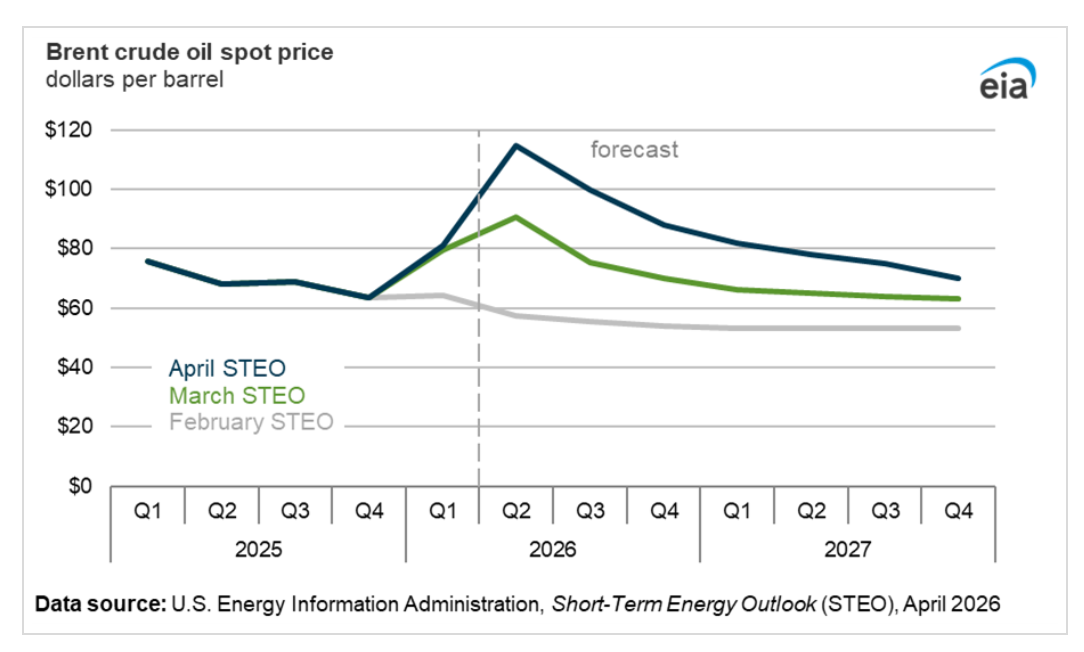
The move itself wasn't the surprise. Geopolitical risk in the Middle East is a permanent feature of crude oil markets. What caught traders was the timing.It broke on a weekend, when NYMEX was closed.
That's when the structural limitations of most crude oil instruments become expensive. ETF holders couldn't reposition until Monday open, by which point the gap had already printed. CFD traders were at the mercy of broker-quoted spreads that widened significantly during the initial volatility. Holders of expiring futures contracts faced rollover decisions under duress. And anyone relying on exchange hours to manage risk found themselves locked out of the market at precisely the moment it mattered most.
These aren't edge cases. Oil markets move on OPEC weekend announcements, Saturday drone strikes, and Sunday diplomatic statements as often as they move on Wednesday inventory reports. Any instrument that only lets you trade during exchange hours is structurally mismatched to how crude oil actually behaves.
Perpetual futures, perps, address this directly. You get the leverage and directional exposure of crude oil futures contracts with no expiry pressure and no rollover cost, on a platform that trades around the clock. When the next supply shock breaks on a weekend, you're positioned to act on it, not waiting for Monday open to find out where the market has already moved.
This guide covers everything you need to know: how crude oil perps work, the difference between WTI and Brent, what drives crude oil price volatility, and how to build and manage a position from open to close.
What Are Crude Oil Futures Contracts?
A crude oil futures contract is a standardised agreement to buy or sell a set quantity of crude oil at a predetermined price on a future date. On traditional exchanges like NYMEX, the benchmark contract, ticker CL, represents 1,000 barrels of West Texas Intermediate crude oil.
Futures exist because both oil producers and refiners need price certainty. A producer drilling today doesn't want their revenue to collapse if prices fall before delivery. A refiner buying months in advance doesn't want to absorb a price spike. Traders fill the gap between those two parties, providing liquidity in exchange for the opportunity to profit from price moves.
Perpetual futures work the same way, with one key difference: there is no expiry date. Rather than rolling into the next contract before settlement, a perp position stays open indefinitely. The mechanism that keeps perp prices anchored to spot is the funding rate, a periodic payment exchanged between long and short positions based on whether the perp is trading at a premium or discount to the index price. When longs are paying funding to shorts, the market is leaning bullish, and vice versa. Watching funding rate direction is itself a useful signal.
WTI vs Brent: Which Crude Oil Perp Should You Trade?
The two global crude oil benchmarks behave differently, and the spread between them, typically called the WTI-Brent spread, is actively traded as its own position by institutional desks.
| WTI (West Texas Intermediate) | Brent Crude | |
|---|---|---|
| Origin | Permian Basin, Texas, USA | North Sea (UK/Norway) |
| Exchange | NYMEX (CME Group) | ICE (Intercontinental Exchange) |
| Ticker | CL | BRN / CO |
| Sulphur content | Light, sweet (low sulphur) | Light, sweet (slightly higher sulphur) |
| Primary use | US domestic pricing benchmark | Global export pricing benchmark (~70% of world contracts) |
| Typical spread | Usually trades at a discount to Brent | Global reference price |
| Volatility | Higher intraday volatility | Slightly smoother, more globally influenced |
Which should you trade?
- WTI perps are better for traders focused on US supply dynamics: EIA inventory reports, Permian output data, pipeline capacity, and Fed rate decisions that affect USD strength.
- Brent perps track global supply more closely: OPEC+ production decisions, Middle East geopolitics, and European demand signals carry more weight.
If you're just starting out, WTI typically offers tighter spreads and higher retail trading volume. If you're already following macroeconomic flows and OPEC news, Brent gives you more global context.
The WTI-Brent spread itself currently ranging from $2–$5 per barrel in normal conditions, but capable of widening significantly during supply disruptions, is worth tracking even if you're only trading one side. A widening spread often signals US-specific supply bottlenecks; a narrowing spread suggests global demand pressure is absorbing US inventory.
What Moves Crude Oil Prices
Crude oil price volatility is driven by a handful of recurring, predictable catalysts. Understanding them is more important than any technical setup.
1. EIA and API Inventory Reports
The US Energy Information Administration (EIA) publishes its Weekly Petroleum Status Report every Wednesday at 10:30 AM EST. The American Petroleum Institute (API) releases its own estimate the evening before.
A crude oil draw (inventory declining) is typically bullish — demand is absorbing supply. A crude oil build (inventory increasing) is bearish. The market usually reacts within seconds of the headline number, so most retail traders avoid holding through the release unless they have a clear view.
2. OPEC+ Production Decisions
The Organisation of the Petroleum Exporting Countries, plus allied producers (collectively OPEC+), controls roughly 40% of global crude oil output. Production cut announcements push prices up; increases push them down. These decisions are scheduled but frequently adjusted — surprise announcements at off-cycle meetings are common and create the most violent price moves.
3. Geopolitical Risk
Supply disruptions in key producing regions — the Middle East, Russia, Libya — create immediate price spikes. These are harder to trade systematically but worth monitoring as background risk.
4. USD Strength
Crude oil is priced globally in US dollars. When the dollar strengthens, oil becomes more expensive for buyers holding other currencies, which suppresses demand. Dollar weakness has the opposite effect. Watch DXY alongside your oil chart.
5. Macro Demand Signals
GDP data from China (the world's largest crude importer), US manufacturing PMI, and global shipping rates are all leading indicators of crude demand. A slowdown in Chinese industrial activity often precedes a softening in oil prices by several weeks.
How Crude Oil Perps Work: Key Mechanics
Before placing your first trade, understand these four mechanics.
Leverage. Crude oil perps allow you to control a position much larger than your margin. A 10x leveraged position on WTI means a 5% price move in your favour doubles your margin but a 5% move against you wipes it. Size accordingly.
Funding rate. Every 8 hours (frequency varies by exchange), a funding payment is exchanged between long and short holders. If funding is positive, longs pay shorts; if negative, shorts pay longs. A persistently high positive funding rate suggests the market is overly long, a useful contrarian signal.
Liquidation price. Your position is automatically closed if the mark price reaches your liquidation level. Always know your liquidation price before entry. On Grvt, you can see it in real time on your position panel.
Mark price vs last price. Liquidations are triggered by the mark price — a fair-value estimate based on the underlying index, not the last traded price. This protects against temporary wicks or low-liquidity price spikes triggering unnecessary liquidations.
How to Trade Crude Oil Perps on Grvt
Grvt is a privacy-first, institutional-grade decentralized exchange built on zkSync, offering WTI and Brent perpetual futures with deep liquidity, low latency execution, and 24/7 availability. Unlike NYMEX, which closes on weekends and has defined settlement windows, Grvt perps trade continuously, meaning you can respond to an OPEC weekend announcement or a geopolitical event in real time rather than waiting for Monday open.
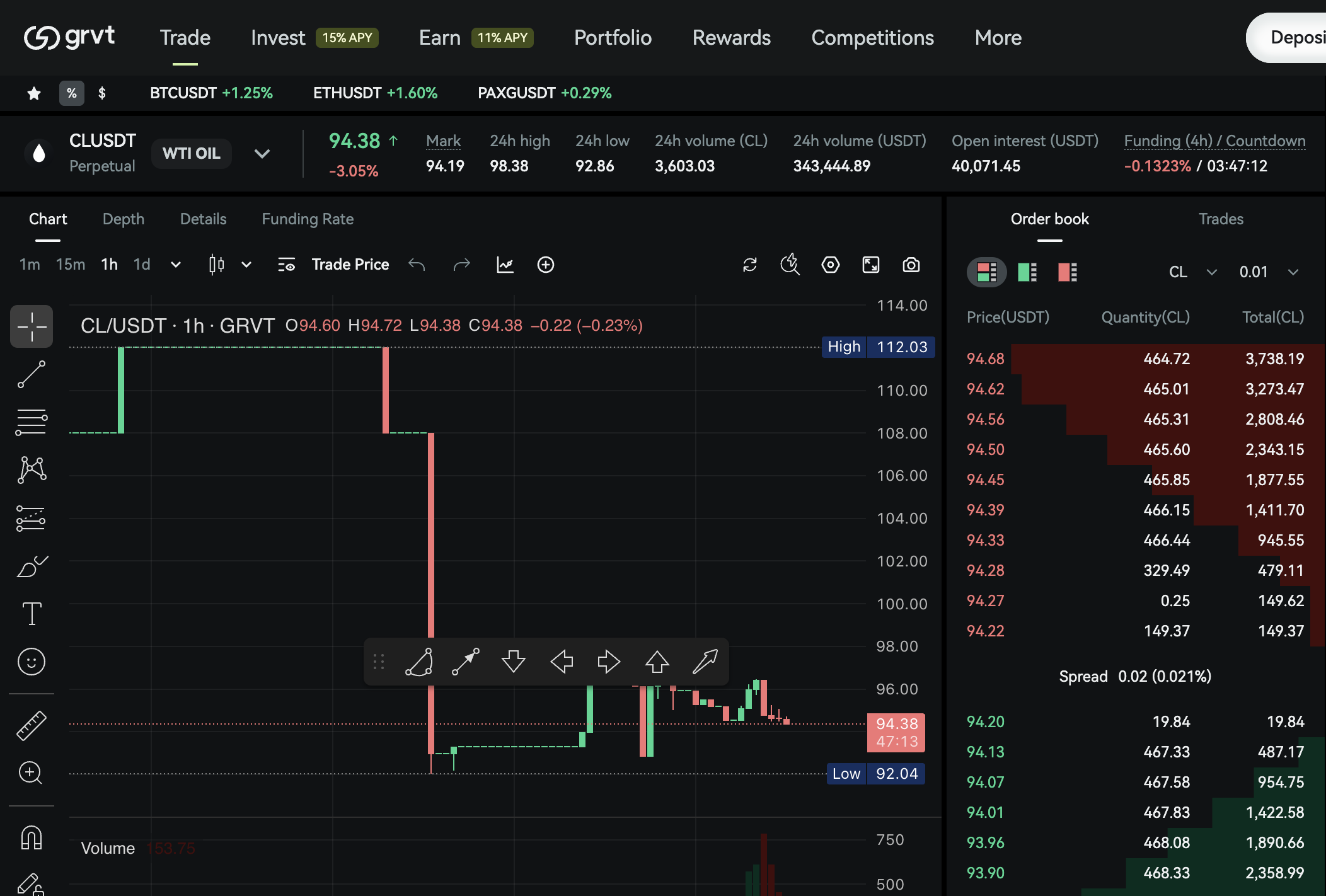
Here's how to open a crude oil perp position:
- Go to the CL-USDT perpetual market at https://grvt.io/exchange/perpetual/CL-USDT
- Select your order type. Limit orders give you price control and avoid slippage; market orders fill immediately at best available price.
- Set your leverage. Start conservatively. Crude oil is a volatile instrument. 3–5x is a reasonable range for most active traders.
- Check the funding rate before entry. If funding is heavily positive and you're planning a long, you're paying a recurring cost to hold. Factor that into your time horizon.
- Set your stop loss. Determine your maximum acceptable loss before entry, not after. Place your stop at a level that invalidates your trade thesis, not just a round number below entry.
- Monitor the mark price, not just the last traded price, to track your position relative to liquidation.
Long vs Short: Trading Both Directions
One of the advantages of perpetual futures over oil ETFs is the ability to go short to profit when crude oil prices fall with the same ease as going long.
Going long makes sense when you expect demand to exceed supply: positive inventory draws, OPEC production cuts, or a weakening dollar. Long positions pay funding when the market is in positive funding territory, so they carry a cost in strongly bullish markets.
Going short makes sense during supply builds, demand slowdowns (weak Chinese PMI, rising recession risk), or OPEC+ output increases. Short positions receive funding in positive funding environments, which makes short trades cheaper or even profitable to hold during prolonged bearish periods.
Oil market collapse scenarios, like the 2020 negative WTI price event driven by storage constraints during COVID lockdowns, are extreme examples of where short sellers with proper risk management captured extraordinary returns. Understanding the fundamental conditions that create those setups is what separates systematic traders from reactive ones.
WTI Technical Analysis: What Levels Matter
Crude oil responds well to technical analysis because the same institutional desks are watching the same levels. Key tools:
Round numbers. $70, $75, $80 per barrel are not just psychological levels. They're trigger points for options books and producer hedging programs. Expect increased volatility around these levels.
52-week highs and lows. Breakouts above annual highs or below annual lows attract systematic momentum strategies.
Moving averages. The 50-day and 200-day MAs are widely followed. A sustained break below the 200-day MA is typically bearish; a cross above signals momentum shift.
RSI divergence. In trending crude oil markets, RSI divergence (price making new highs while RSI fails to confirm) is one of the more reliable reversal signals. Use it in conjunction with a fundamental catalyst, not in isolation.
The contango/backwardation structure of the futures curve tells you whether the market is expecting higher or lower prices in the future. Backwardation (near-term prices higher than forward prices) is typically bullish for spot. It means physical buyers are paying up for immediate delivery.
Why Trade Crude Oil Perps Instead of CFDs or ETFs?
| Crude Oil Perp (Grvt) | CFD (Retail Broker) | Oil ETF (USO) | |
|---|---|---|---|
| Expiry | None | None | Rolls monthly (basis risk) |
| Counterparty | On-chain, non-custodial | Broker (custodial) | Fund manager |
| Leverage | Up to 20x | 5–30x (jurisdiction-dependent) | 1x (or leveraged ETF ~2x) |
| Shorting | Native | Yes | Requires inverse ETF |
| Trading hours | 24/7 | Broker-dependent | Market hours only |
| Fees | Taker/maker + funding | Spread + overnight swap | Management fee + roll cost |
| Transparency | On-chain, verifiable | Broker-quoted | Fund disclosed |
CFDs offer similar flexibility but sit entirely within a broker's internal book. You're trading against the broker, not against a market. ETFs are suitable for passive exposure but are expensive to hold long-term due to contango roll costs, and you cannot short them directly.
Crude oil perps on Grvt give you direct market exposure with on-chain settlement, no custodial risk, and a trading environment built for both manual and algorithmic execution.
Frequently Asked Questions
What is the WTI stock price today? WTI crude oil doesn't trade as a stock. It trades as a futures contract (ticker: CL on NYMEX) or as a perpetual futures contract on derivatives exchanges like Grvt. The spot price is quoted in USD per barrel and updates continuously during market hours.
Can oil prices go negative? Yes. In April 2020, WTI front-month futures briefly traded at -$37.63 per barrel as storage capacity filled up during COVID lockdowns and holders of expiring contracts could not take physical delivery. Perpetual futures are not subject to physical delivery, so this specific mechanism doesn't apply, but the event illustrates how extreme crude oil price volatility can become under supply-demand stress.
What causes an oil market collapse? Rapid demand destruction (as in 2020) combined with supply surplus is the typical trigger. OPEC+ price wars, like the Russia-Saudi Arabia dispute in March 2020, can flood the market with supply at precisely the wrong time. Structural factors like US shale production growth have also changed how quickly supply can respond to price signals.
How do I read the crude oil inventory report? Focus on the headline crude build/draw number versus the analyst consensus estimate. A draw that beats expectations by more than 1 million barrels is typically a strong bullish signal. Also check gasoline and distillate inventories, as they indicate whether refined products demand is absorbing upstream supply.
What's the difference between crude oil and Brent? "Crude oil" is the generic term for unrefined petroleum. Brent and WTI are specific grade. Brent is extracted from the North Sea and serves as the global export benchmark; WTI is extracted in Texas and serves as the US domestic benchmark. Both are light, sweet crudes, but they trade at a persistent price differential based on logistics, storage, and regional demand.
Start Trading Crude Oil Perps on Grvt
If you're ready to take a position in WTI or Brent crude oil, Grvt's perpetual futures market gives you the leverage, liquidity, and 24/7 access to trade through any market condition, including weekend OPEC announcements and after-hours macro events that move traditional futures the following Monday open.
Trade Crude Oil Perps and More on Grvt →
Read More
- How to Trade RWA Perps
- How to Trade Tokenized Stocks
- How To Trade Tokenized ETFs
- How to Trade Tokenized Gold and Other Commodities
Trading involves risk. This article is for informational purposes only and does not constitute financial advice.